security
18090 TopicsCIS F5 Benchmark Reporter
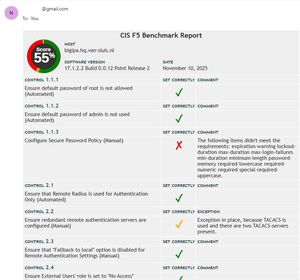
Code is community submitted, community supported, and recognized as ‘Use At Your Own Risk’. The CIS_F5_Benchmark_Reporter.py is a Python script that can be run on a F5 BIG-IP. This script will check if the configuration of the F5 BIG-IP is compliant with the CIS Benchmark for F5. The script will generate a report that can be saved to a file, send by e-mail or send its output to the screen. Just use the appropriate arguments when running the script. [root@bigipa:Active:Standalone] # ./CIS_F5_Benchmark_Reporter.py Usage: CIS_F5_Benchmark_Reporter.py [OPTION]... Mandatory arguments to long options are mandatory for short options too. -f, --file=FILE output report to file. -m, --mail output report to mail. -s, --screen output report to screen. Report bugs to nvansluis@gmail.com [root@bigipa:Active:Standalone] # To receive a daily or weekly report from your F5 BIG-IP, you can create a cron job. Below is a screenshot that shows what the report will look like. Settings In the script, there is a section named 'User Options'. These options should be modified to reflect your setup. #----------------------------------------------------------------------- # User Options - Configure as desired #----------------------------------------------------------------------- E-mail settings Here the e-mail setting can be configured, so the script will be able to send a report by e-mail. # e-mail settings port = 587 smtp_server = "smtp.example.com" sender_email = "johndoe@example.com" receiver_email = "johndoe@example.com" login = "johndoe" password = "mySecret" SNMP settings Here you can add additional SNMP clients. These are necessary to be compliant with control 6.1. # list containing trusted IP addresses and networks that have access to SNMP (control 6.1) snmp_client_allow_list = [ "127.0.0.0/8", ] Exceptions Sometimes there are valid circumstances, why a specific requirement of a security control can't be met. In this case you can add an exception. See the example below. # set exceptions (add your own exceptions) exceptions = { '2.1' : "Exception in place, because TACACS is used instead of RADIUS.", '2.2' : "Exception in place, because TACACS is used and there are two TACACS-servers present." } Recommendations Store the script somewhere in the /shared partition. The data stored on this partition will still be available after an upgrade. Feedback This script has been tested on F5 BIG-IP version 17.x. If you have any questions, remarks or feedback, just let me know. Download The script can be downloaded from github.com. https://github.com/nvansluis/CIS_F5_Benchmark_Reporter294Views7likes4CommentsF5 Threat Report - December 31st, 2025
Fortinet Warns of 5-Year-Old FortiOS 2FA Bypass Still Exploited in Attacks Fortinet has issued a warning regarding the continued active exploitation of CVE-2020-12812, a critical FortiOS vulnerability dating back five years. This improper authentication flaw, found in FortiGate SSL VPN, enables threat actors to bypass two-factor authentication (2FA) by manipulating the case of a username. The vulnerability arises from inconsistent case-sensitive matching between local and remote authentication when 2FA is enabled for local users linked to a remote authentication method like LDAP. Fortinet released patches in July 2020 with FortiOS versions 6.4.1, 6.2.4, and 6.0.10, and advised disabling username-case-sensitivity as a workaround. Despite these measures, the flaw is still being exploited, particularly against firewalls with LDAP enabled, under specific conditions where local user entries requiring 2FA are linked to LDAP and belong to an LDAP group configured on the FortiGate. Both the FBI and CISA have previously highlighted the exploitation of CVE-2020-12812 by state-backed hackers and ransomware groups, with CISA adding it to its catalog of known exploited vulnerabilities in November 2021, mandating federal agencies to secure their systems. Severity: Critical Sources https://cyberpress.org/hackers-abuse-3-year-old-fortigate-flaw/ https://gbhackers.com/unpatched-fortigate-security-flaw/ https://meterpreter.org/how-a-capital-letter-bypasses-fortinet-2fa/ https://securityonline.info/hackers-revive-2020-fortigate-flaw-to-bypass-2fa/ https://thehackernews.com/2025/12/fortinet-warns-of-active-exploitation.html https://www.bleepingcomputer.com/news/security/fortinet-warns-of-5-year-old-fortios-2fa-bypass-still-exploited-in-attacks/ https://www.securityweek.com/fortinet-warns-of-new-attacks-exploiting-old-vulnerability/ https://www.techzine.eu/news/security/137548/attackers-exploit-five-year-old-fortinet-vulnerability/ Threat Details and IOCs Malware: Hive, HiveLeaks, Mac.c, MacSync, MacSync Stealer CVEs: CVE-2020-12812 Technologies: Fortinet FortiGate, Fortinet FortiOS, Microsoft Active Directory Threat Actors: APT3, APT35, CharmingKitten, CobaltIllusion, CobaltMirage, COBALT MIRAGE, Hive, ImperialKitten, PHOSPHOROUS, Play Attacker Countries: Iran Victim Industries: Commercial Facilities, Education, Energy, Financial Services, Government, Healthcare, Information Technology, Manufacturing, Technology Hardware, Telecommunications, Transportation Victim Countries: Australia, Canada, France, Germany, Italy, Spain, United Kingdom, United States Mitigation Advice Patch all vulnerable FortiGate firewalls to FortiOS version 6.4.1, 6.2.4, 6.0.10, or a more recent version to remediate CVE-2020-12812. If immediate patching is not feasible, disable username case sensitivity on vulnerable FortiGate firewalls as a temporary workaround to prevent exploitation. Review FortiGate authentication configurations and immediately remove any secondary LDAP groups that are not explicitly required for business operations. Compliance Best Practices Establish a comprehensive vulnerability management program that includes asset inventory, regular scanning, risk-based prioritization, and defined Service Level Agreements (SLAs) for patching internet-facing systems. Develop and enforce security configuration baselines for all network devices, including FortiGate firewalls. Implement a regular, automated audit process to detect and remediate deviations from these approved baselines. Conduct a strategic review of the remote access authentication architecture to identify and simplify complex integrations, such as those between FortiGate local users and remote LDAP directories, in favor of more robust and less error-prone solutions. “Headphone Jacking”: Critical Flaws in Airoha Bluetooth SoCs Hijack Phones via Earbuds A new report from ERNW Enno Rey Netzwerke GmbH details "Headphone Jacking," a series of critical vulnerabilities (CVE-2025-20700, CVE-2025-20701, CVE-2025-20702) found in Airoha Bluetooth Systems on a Chip (SoCs) widely used in popular True Wireless Stereo (TWS) earbuds and headphones from brands like Sony (e.g., WH-1000XM5, WF-1000XM5), JBL (e.g., Live Buds 3), Marshall (e.g., Major V), and Beyerdynamic (e.g., Amiron 300). These flaws stem from an unauthenticated, exposed proprietary diagnostic protocol called RACE, accessible over Bluetooth Classic and BLE, which allows attackers within range to connect to headphones, read/write memory, eavesdrop via the microphone, and spy on media. By chaining these vulnerabilities, attackers can perform "Headphone Jacking," stealing the Bluetooth Link Key from the headphone's flash memory to impersonate the trusted device and hijack the connected smartphone, enabling actions such as triggering voice assistants, sending text messages, or silently accepting calls and receiving audio streams. While some manufacturers are releasing patches, the fragmented Bluetooth market leaves many devices vulnerable, prompting recommendations for immediate firmware updates or, for high-risk individuals, the use of wired headphones. Severity: Critical Sources https://cyberpress.org/new-bluetooth-headphone-vulnerabilities/ https://securityonline.info/headphone-jacking-critical-flaws-in-popular-earbuds-let-hackers-hijack-your-phone/ Threat Details and IOCs CVEs: CVE-2025-20700, CVE-2025-20701, CVE-2025-20702 Technologies: Airoha Bluetooth SoC, Apple iOS, beyerdynamic, Bose, Google Android, Jabra, JBL, Marshall Victim Industries: Consumer Electronics, Semiconductors Victim Countries: Denmark, Germany, Japan, Sweden, Taiwan, United States Mitigation Advice Compile an inventory of all Bluetooth headphones used by employees, cross-referencing the list with the models mentioned in the article (e.g., Sony WH-1000XM5, JBL Live Buds 3) to identify potentially vulnerable Airoha-based devices. Instruct users with identified vulnerable headphone models to immediately check for and apply the latest firmware updates provided by the manufacturer via their respective mobile applications. Issue a security advisory to all employees, with specific guidance for high-risk individuals such as executives and finance personnel, recommending they use wired headphones until their Bluetooth devices are confirmed to be patched. Use the 'RACE Toolkit' released by ERNW to actively scan and verify the vulnerability status of corporate-issued or high-risk employee headphones. Compliance Best Practices Develop and implement a corporate policy governing the use of personal and corporate-issued peripheral devices, including Bluetooth headphones, specifying approved models and minimum security requirements. Establish a formal process for tracking and managing firmware updates for all approved IoT and peripheral devices, including headphones, to ensure they are patched in a timely manner. Update the security awareness training program to include modules on the risks associated with Bluetooth peripherals, teaching users how to update device firmware and recognize signs of compromise. Investigate and deploy Mobile Device Management (MDM) policies to restrict or control Bluetooth pairing on corporate smartphones, allowing connections only to approved and managed peripherals. LangChain Serialization Flaw (CVE-2025-68664) Enables Secret Extraction, Code Execution A critical serialization vulnerability, identified as CVE-2025-68664 (CVSS 9.3) for Python and CVE-2025-68665 (CVSS 8.6) for JavaScript, has been discovered in the LangChain ecosystem, affecting `langchain-core` and LangChain.js packages. Reported by Yarden Porat on December 4, 2025, and internally dubbed "LangGrinch," the flaw stems from improper handling of the internal `lc` key during serialization and deserialization by the `dumps()` and `dumpd()` functions. This allows user-controlled data containing the `lc` key to be misinterpreted as legitimate internal LangChain objects, leading to various impacts including secret extraction from environment variables (when `secrets_from_env` is enabled), arbitrary object creation, instantiation of classes from trusted namespaces, and potential arbitrary code execution via Jinja2 templates. A significant attack vector involves prompt injection through LLM response fields such as `metadata`, ``additional_kwargs`,` or ``response_metadata`.` Patches have been released, with `langchain-core` fixed in versions 1.2.5 and 0.3.81, `@langchain/core` in 1.1.8 and 0.3.80, and `langchain` in 1.2.3 and 0.3.37. These updates introduce an `allowed_objects` parameter for explicit class control during deserialization, disable Jinja2 templates by default, and turn off automatic loading of secrets from the environment. Users are strongly advised to update immediately to mitigate these risks, which underscore how classic deserialization vulnerabilities persist in AI-driven systems where model output must still be treated as untrusted input. Severity: Critical Sources https://cyata.ai/blog/langgrinch-langchain-core-cve-2025-68664/ https://gbhackers.com/critical-langchain-vulnerability/ https://securityonline.info/the-lc-leak-critical-9-3-severity-langchain-flaw-turns-prompt-injections-into-secret-theft/ https://socradar.io/blog/cve-2025-68664-langchain-flaw-secret-extraction/ https://sploitus.com/exploit?id=EEF971FE-5365-544C-A6DE-F7C32033DE93 https://thehackernews.com/2025/12/critical-langchain-core-vulnerability.html https://www.securitylab.ru/news/567625.php Threat Details and IOCs CVEs: CVE-2023-36188, CVE-2024-27302, CVE-2025-68613, CVE-2025-68664, CVE-2025-68665 Technologies: Jinja2, LangChain Core, LangChainGo, Microsoft TypeScript, n8n, Node.js, Python Victim Industries: E-commerce, Financial Services, Food Delivery, Government, Healthcare, IT Services, Legal Services, Logistics, Manufacturing, Professional Services, Recruitment, Retail, Software, Software as a Service (SaaS), Sports and Entertainment, Technology Hardware, Telecommunications Mitigation Advice Update all Python applications using the `langchain-core` package to version 1.2.5 or newer, or to version 0.3.81 or newer, to mitigate CVE-2025-68664. Update all JavaScript/TypeScript applications using the `@langchain/core` package to version 1.1.8 or newer (or 0.3.80 or newer) and the `langchain` package to version 1.2.3 or newer (or 0.3.37 or newer) to mitigate CVE-2025-68665. Perform an immediate scan of all code repositories and deployed applications to identify all instances of the vulnerable `langchain-core`, `@langchain/core`, and `langchain` packages and their versions. In all applications using LangChain, immediately review configurations and explicitly set the `secrets_from_env` (Python) and `secretsFromEnv` (JavaScript) parameters to `false` to prevent unauthorized access to environment variables. Compliance Best Practices Implement a secure development policy that mandates treating all output from Large Language Models (LLMs) as untrusted external input, requiring strict validation and sanitization before it is processed by sensitive functions like deserializers. Refactor all applications that use LangChain's deserialization functions (`load()`, `loads()`) to use the `allowed_objects` parameter, creating a strict allowlist of only the specific classes required for the application to function. Review and re-architect applications using AI/ML frameworks to operate under the Principle of Least Privilege, ensuring their execution environments are isolated and have access to the minimum set of secrets and permissions necessary for their function. Establish a secure baseline configuration standard for all AI/ML frameworks that disables high-risk features, such as remote code execution via templating engines, by default. Require a formal security review and exception process to enable them. Trust Wallet Confirms Extension Hack Led to $7 Million Crypto Theft On December 24, a compromised update to the Trust Wallet Chrome extension, specifically version 2.68.0, resulted in the theft of $7 million in cryptocurrency, with users reporting their wallets drained shortly after interacting with the extension. Security researchers identified malicious code within the 2.68.0 update, which exfiltrated sensitive wallet data, including seed phrases, to an external server hosted at `api.metrics-trustwallet[.]com`, a domain registered just days prior to the incident. Trust Wallet confirmed the security breach, advising affected users to immediately disable version 2.68.0 and update to the secure version 2.69; mobile-only users and other browser extension versions were not impacted. Binance founder Changpeng "CZ" Zhao stated that Trust Wallet would cover the losses. Simultaneously, a phishing campaign emerged, utilizing domains such as `fix-trustwallet[.]com` to impersonate Trust Wallet and solicit users' recovery seed phrases under the pretense of a "vulnerability fix." Users whose wallets may have been compromised are urged to transfer any remaining funds to a new wallet secured with a fresh seed phrase. Severity: Critical Sources https://buaq.net/go-383910.html https://coinedition.com/trust-wallet-confirms-extension-v2-68-security-issue-after-wallet-drains/ https://cyberinsider.com/trust-wallet-suffers-supply-chain-compromise-millions-in-crypto-stolen/ https://cyberpress.org/trust-wallet-chrome-plugin-under-attack/ https://financefeeds.com/trust-wallet-opens-claims-process-after-7m-chrome-extension-hack/ https://financefeeds.com/trust-wallet-reimburse-users-20m-hack-cz-confirms/ https://gbhackers.com/hackers-compromise-trust-wallet-chrome-extension/ https://malwaretips.com/threads/trustwallet-chrome-extension-hacked-%E2%80%93-users-reporting-millions-in-losses.138907/ https://securityonline.info/the-christmas-drain-how-a-backdoor-in-trust-wallet-v2-68-stole-7m/ https://slowmist.medium.com/christmas-heist-analysis-of-trust-wallet-browser-extension-hack-bdb35c3cc6dd?source=rss-4ceeedda40e8------2 https://thehackernews.com/2025/12/trust-wallet-chrome-extension-bug.html https://www.bleepingcomputer.com/news/security/trust-wallet-chrome-extension-hack-tied-to-millions-in-losses/ https://www.bleepingcomputer.com/news/security/trust-wallet-confirms-extension-hack-led-to-7-million-crypto-theft/ https://www.cryptoninjas.net/news/7m-lost-in-trust-wallet-browser-hack-cz-confirms-full-compensation-as-extension-flaw-exposed/ https://www.tronweekly.com/trust-wallet-pledges-to-cover-7m-lost-in/ https://www.tronweekly.com/trust-wallet-to-cover-7m-lost-on-hack/ Threat Details and IOCs Malware: Mac.c, MacSync, MacSync Stealer CVEs: CVE-2023-31290 Technologies: Brave Browser, Google Chrome, Google Chrome Web Store, Microsoft Edge, Opera, Trust Wallet Attacker Countries: North Korea, United Kingdom Attacker Domains: api.metrics-trustwallet.com, fix-trustwallet.com, metrics-trustwallet.com Attacker URLs: https://api.metrics-trustwallet.com, hxxp://api.metrics-trustwallet.com Victim Industries: Blockchain, Financials, Financial Services, Financial Technology, Information Technology, Software, Technology Hardware Victim Countries: Hong Kong, Russia, Singapore, United States, Vietnam Mitigation Advice Add the domains `api.metrics-trustwallet[.]com` and `fix-trustwallet[.]com` to the network firewall's blocklist. Configure the corporate DNS filtering service to block resolution of the domains `api.metrics-trustwallet[.]com` and `fix-trustwallet[.]com`. Use the endpoint management tool to scan all corporate devices for the presence of the Trust Wallet Chrome extension, specifically version 2.68.0, and report any findings to the security team for remediation. Send a company-wide security bulletin warning employees about the Trust Wallet supply chain attack and its associated phishing campaign. Instruct users to never enter credentials or recovery phrases in response to unsolicited prompts and to report suspicious browser behavior. Compliance Best Practices Develop and implement a corporate policy to only allow approved browser extensions on company devices, enforcing this policy via browser management tools like Group Policy or an MDM solution. Establish a formal supply chain risk management process to vet the security posture of all third-party software vendors and applications, including browser extensions, before they are approved for use in our environment. Incorporate modules on the risks of browser extensions and supply chain attacks into the recurring security awareness training program, reinforcing lessons with periodic phishing simulations. Design and implement a network egress filtering policy on the perimeter firewall to deny outbound traffic by default, only allowing connections to known-good, categorized, and business-required destinations. React2Shell Explained (CVE-2025-55182): From Vulnerability Discovery to Exploitation A critical remote code execution (RCE) vulnerability, identified as CVE-2025-55182 and dubbed React2Shell, exists within the React Server Components (RSC) architecture, allowing unauthenticated attackers to execute arbitrary code on vulnerable servers via a single crafted HTTP request. This flaw exploits weaknesses in the React Flight protocol's deserialization process, specifically by manipulating prototype chains and injecting malicious code during server-side rendering. The exploit chain leverages JavaScript's prototype traversal `(`__proto__:constructor`),` the thenable behavior, the `@` syntax for raw chunk objects, forced execution of `initializeModelChunk()`, context confusion through the `_response` object, and blob resolution to trigger the `Function()` constructor with attacker-controlled code. Affected software includes React versions 19.0.0 through 19.2.0, Next.js applications utilizing the App Router (versions 16.0.0-16.0.6, 15.x, and early 16.x releases), and associated serialization libraries like `react-server-dom-webpack`, `react-server-dom-parcel`, and `react-server-dom-turbopack` prior to vendor patches. Due to the widespread adoption of React and Next.js, this vulnerability presents a significant risk, bypassing traditional security defenses. Immediate mitigation requires upgrading to React 19.2.1+ and Next.js 16.0.7+, regenerating all secrets and credentials, implementing WAF/API Gateway rules to detect suspicious React Flight chunk structures or references to `__proto__` or `prototype`, hardening RSC/Next.js deployments with minimal privileges and isolation, and actively hunting for indicators of compromise such as unexpected `.then()` behavior or shell command execution from Node.js processes. Severity: Critical Sources https://arcticwolf.com/resources/blog/cve-2025-55182/ https://arcticwolf.com/resources/blog-uk/cve-2025-55182-critical-remote-code-execution-vulnerability-found-in-react-server-components/ https://arstechnica.com/security/2025/12/admins-and-defenders-gird-themselves-against-maximum-severity-server-vulnerability/ https://blog.checkpoint.com/securing-the-cloud/what-is-react2shell-cve-2025-55182-in-plain-english-and-why-check-point-cloudguard-waf-customers-carried-on-with-their-day/ https://blog.cloudflare.com/5-december-2025-outage/ https://blog.cloudflare.com/react2shell-rsc-vulnerabilities-exploitation-threat-brief/ https://blog.jakesaunders.dev/my-server-started-mining-monero-this-morning/ https://blog.qualys.com/product-tech/2025/12/10/react2shell-decoding-cve-2025-55182-the-silent-threat-in-react-server-components https://blog.securelayer7.net/cve-2025-55182/ https://bluefire-redteam.com/critical-react-next-js-vulnerability/ https://buaq.net/go-379373.html https://buaq.net/go-379393.html https://buaq.net/go-379471.html https://buaq.net/go-379472.html https://buaq.net/go-379487.html https://buaq.net/go-379621.html https://buaq.net/go-379669.html https://buaq.net/go-379678.html https://buaq.net/go-379693.html https://buaq.net/go-379725.html https://buaq.net/go-379832.html https://buaq.net/go-379834.html https://buaq.net/go-379997.html https://buaq.net/go-380062.html https://buaq.net/go-380063.html https://buaq.net/go-380074.html https://buaq.net/go-380124.html https://buaq.net/go-380126.html https://buaq.net/go-380241.html https://buaq.net/go-380275.html https://buaq.net/go-380329.html https://buaq.net/go-381014.html https://buaq.net/go-381261.html https://buaq.net/go-381582.html https://buaq.net/go-382312.html https://buaq.net/go-382608.html https://buaq.net/go-382617.html https://cloud.google.com/blog/products/identity-security/responding-to-cve-2025-55182/ https://cloud.google.com/blog/topics/threat-intelligence/threat-actors-exploit-react2shell-cve-2025-55182/ https://coinedition.com/cloudflare-outage-exposes-centralized-internet-risks-for-crypto-platforms/ https://csirt.divd.nl/cases/DIVD-2025-00042/ https://cxsecurity.com/issue/WLB-2025120005 https://cxsecurity.com/issue/WLB-2025120006 https://cxsecurity.com/issue/WLB-2025120023 https://cyberinsider.com/chinese-hackers-rapidly-exploit-critical-react2shell-flaw/ https://cyberinsider.com/react2shell-exploitation-explodes-as-botnets-now-join-the-fray/ https://cyberinsider.com/react2shell-flaw-threatens-rce-in-39-of-all-cloud-environments/ https://cyberpress.org/2-15m-next-js-sites-found-vulnerable/ https://cyberpress.org/burp-suite-act2shell-vulnerabilities/ https://cyberpress.org/fake-mparivahan-e-challan-apps/ https://cyberpress.org/new-scanner-tool-for-detecting/ https://cyberpress.org/openai-gpt-5-2-codex-vulnerability-detection/ https://cyberpress.org/react2shell-etherrat-deployment/ https://cyberpress.org/react2shell-exploitation-campaign/ https://cyberpress.org/react2shell-vulnerability/ https://cyberpress.org/react2shell-vulnerability-2/ https://cyberpress.org/react2shell-vulnerability-3/ https://cyberpress.org/react2shell-vulnerability-4/ https://cyberpress.org/react4shell-flaw/ https://cyberpress.org/react-and-next-js-vulnerabilities/ https://cyberpress.org/react-server-components-flaw/ https://cyberscoop.com/attackers-exploit-react-server-vulnerability/ https://cyberscoop.com/react2shell-vulnerability-fallout-spreads/ https://cyberscoop.com/react-server-vulnerability-critical-severity-security-update/ https://cybersrcc.com/2025/12/10/critical-security-advisory-on-cve-2025-66478-and-its-active-exploitation-risks/ https://cyberveille.esante.gouv.fr/alertes/react-cve-2025-55182-2025-12-04 https://doublepulsar.com/cybersecurity-industry-overreacts-to-react-vulnerability-starts-panic-burns-own-house-down-again-e85c10ad1607?source=rss----8343faddf0ec---4 https://financefeeds.com/hackers-exploit-javascript-library-to-deploy/ https://gbhackers.com/2-15m-next-js-web-services-exposed-online-active-attacks-reported/ https://gbhackers.com/644k-websites-at-risk-due-to-critical-react-server-components-flaw/ https://gbhackers.com/burp-suite-upgrades-scanner-for-critical-react2shell-flaws/ https://gbhackers.com/cisa-adds-critical-react2shell-vulnerability-to-kev-catalog/ https://gbhackers.com/critical-react2shell-rce-flaw/ https://gbhackers.com/new-scanner-released-to-detect-exposed-reactjs-and-next-js-rsc-endpoints/ https://gbhackers.com/next-js-releases-scanner-react2shell-vulnerability/ https://gbhackers.com/openais-gpt-5-2-codex-boosts-agentic-coding/ https://gbhackers.com/react2shell-rce-vulnerability/ https://gbhackers.com/react2shell-vulnerability/ https://github.com/vercel/next.js/security/advisories/GHSA-9qr9-h5gf-34mp https://gridinsoft.com/blogs/react2shell-cve-2025-55182-rce/ https://gridinsoft.com/blogs/react2shell-exploitation-china-apt/ https://hackread.com/north-korean-hackers-etherrat-malware-react2shell/ https://horizon3.ai/attack-research/vulnerabilities/cve-2025-55182/ https://industrialcyber.co/threats-attacks/amazon-warns-of-ongoing-exploitation-attempts-by-chinese-hackers-on-react2shell-vulnerability/ https://infosecwriteups.com/from-recon-to-rce-hunting-react2shell-cve-2025-55182-for-bug-bounties-4e3a3ed79876?source=rss----7b722bfd1b8d---4 https://isc.sans.edu/diary/32572 https://isc.sans.edu/diary/rss/32572 https://jfrog.com/blog/2025-55182-and-2025-66478-react2shell-all-you-need-to-know/ https://lab.wallarm.com/update-on-react-server-components-rce-vulnerability-cve-2025-55182-cve-2025-66478/ https://lab.wallarm.com/wallarm-blocks-exploitation-remote-code-execution-vulnerability-react-server-components/ https://malwaretips.com/threads/etherrat-dprk-uses-novel-ethereum-implant-in-react2shell-attacks.138645/ https://malwaretips.com/threads/multiple-threat-actors-exploit-react2shell-cve-2025-55182-according-to-google.138719/ https://malwaretips.com/threads/react2shell-technical-deep-dive-in-the-wild-exploitation-of-cve-2025-55182.138631/ https://meterpreter.org/beyond-the-shell-critical-react2shell-exploit-hits-japan-to-deploy-stealthy-zndoor-rat/ https://meterpreter.org/china-apts-exploiting-react-server-rce-cve-2025-55182-hours-after-disclosure/ https://meterpreter.org/cloudflare-outage-caused-by-frantic-patching-of-critical-react2shell-cve-2025-55182-flaw/ https://meterpreter.org/react2shell-exploit-botnets-target-150k-devices-daily-with-node-js-flaw/ https://news.sophos.com/en-us/2025/12/11/react2shell-flaw-cve-2025-55182-exploited-for-remote-code-execution/ https://nextjs.org/blog/CVE-2025-66478 https://nsfocusglobal.com/react-next-js-remote-code-execution-vulnerability-cve-2025-55182-cve-2025-66478-notice/ https://orca.security/resources/blog/cve-2025-55182-react-nextjs-rce/ https://osintteam.blog/cve-2025-55182-a-pre-authentication-remote-code-execution-in-next-js-complete-guide-e39a35fa3156?source=rss----2983bc435765---4 https://osintteam.blog/react2shell-analysis-domain-level-detection-of-rsc-exposure-11db354612df?source=rss----2983bc435765---4 https://osintteam.blog/react2shell-cve-2025-55182-under-active-attack-analysis-of-global-threat-activity-against-rsc-68eb16c893cc?source=rss----2983bc435765---4 https://react.dev/blog/2025/12/03/critical-security-vulnerability-in-react-server-components https://rhisac.org/threat-intelligence/react-nextjs-vuln/ https://sec.cloudapps.cisco.com/security/center/content/CiscoSecurityAdvisory/cisco-sa-react-flight-TYw32Ddb?vs_f=Cisco%20Security%20Advisory%26vs_cat=Security%20Intelligence%26vs_type=RSS%26vs_p=Remote%20Code%20Execution%20Vulnerability%20in%20React%20and%20Next.js%20Frameworks:%20December%202025%26vs_k=1 https://securelist.com/cve-2025-55182-exploitation/118331/ https://securityboulevard.com/2025/12/attackers-worldwide-are-zeroing-in-on-react2shell-vulnerability/ https://securityboulevard.com/2025/12/cloudflare-forces-widespread-outage-to-mitigate-exploitation-of-maximum-severity-vulnerability-in-react2shell/ https://securityboulevard.com/2025/12/dangerous-rce-flaw-in-react-next-js-threatens-cloud-environments-apps/ https://securityboulevard.com/2025/12/exploitation-efforts-against-critical-react2shell-flaw-accelerate/ https://securityboulevard.com/2025/12/google-finds-five-china-nexus-groups-exploiting-react2shell-flaw/ https://securityboulevard.com/2025/12/react-fixes-two-new-rsc-flaws-as-security-teams-deal-with-react2shell/ https://securitylabs.datadoghq.com/articles/cve-2025-55182-react2shell-remote-code-execution-react-server-components/ https://securityonline.info/catastrophic-react-flaw-cve-2025-55182-cvss-10-0-allows-unauthenticated-rce-on-next-js-and-server-components/ https://securityonline.info/critical-react2shell-vulnerability-cve-2025-55182-analysis-surge-in-attacks-targeting-rsc-enabled-services-worldwide/ https://securityonline.info/maximum-severity-alert-critical-rce-flaw-hits-next-js-cve-2025-66478-cvss-10-0/ https://securityonline.info/nexusroute-uncovered-android-rat-impersonates-indian-e-challan-via-github-for-upi-fraud-surveillance/ https://securityonline.info/operation-pcpcat-60000-next-js-servers-hijacked-in-just-48-hours/ https://securityonline.info/react2shell-crisis-critical-vulnerability-triggers-global-cyberattacks-by-state-sponsored-groups/ https://securityonline.info/react2shell-max-score-rce-cvss-10-0-triggers-widespread-exploitation-by-espionage-groups-miners/ https://securityonline.info/react2shell-storm-china-nexus-groups-weaponize-critical-react-flaw-hours-after-disclosure/ https://socprime.com/blog/react2shell-vulnerability-exploitation/ https://socradar.io/blog/react2shell-rce-flaw-react-nextjs/ https://testbnull.medium.com/and-then-and-then-and-then-give-me-the-react2-shell-3c4b60ebaef9?source=rss-6ac51190917c------2 https://thecyberexpress.com/pcpcat-react-servers-nextjs-breach/ https://thecyberexpress.com/react2shell-flaw-exploited-by-chinese-groups/ https://thehackernews.com/2025/12/chinese-hackers-have-started-exploiting.html https://thehackernews.com/2025/12/critical-react2shell-flaw-added-to-cisa.html https://thehackernews.com/2025/12/critical-rsc-bugs-in-react-and-nextjs.html https://thehackernews.com/2025/12/react2shell-exploitation-delivers.html https://thehackernews.com/2025/12/react2shell-exploitation-escalates-into.html https://threatprotect.qualys.com/2025/12/04/react-server-components-rsc-remote-code-execution-vulnerabilities/ https://www.attackiq.com/2025/12/18/cve-2025-55182/ https://www.bitdefender.com/en-us/blog/businessinsights/advisory-react2shell-critical-unauthenticated-rce-in-react-cve-2025-55182 https://www.bleepingcomputer.com/news/security/cloudflare-blames-todays-outage-on-emergency-react2shell-patch/ https://www.bleepingcomputer.com/news/security/critical-react2shell-flaw-exploited-in-ransomware-attacks/ https://www.bleepingcomputer.com/news/security/north-korean-hackers-exploit-react2shell-flaw-in-etherrat-malware-attacks/ https://www.bleepingcomputer.com/news/security/react2shell-critical-flaw-actively-exploited-in-china-linked-attacks/ https://www.bleepingcomputer.com/news/security/react2shell-flaw-exploited-to-breach-30-orgs-77k-ip-addresses-vulnerable/ https://www.catonetworks.com/blog/cato-ctrl-react2shell-vulnerability-targeting-react-server-components/ https://www.computerweekly.com/news/366635992/Cloudflare-fixes-second-outage-in-a-month https://www.computerweekly.com/news/366636015/Cyber-teams-on-alert-as-React2Shell-exploitation-spreads https://www.cybereason.com/blog/cve-2025-55182-rce-vulnerability https://www.cyberkendra.com/2025/12/critical-react2shell-vulnerability.html https://www.cyberkendra.com/2025/12/react2shell-exploited-cisa-issues.html https://www.cyberkendra.com/2025/12/react-patches-two-new-flaws-following.html https://www.darkreading.com/threat-intelligence/react2shell-exploits-flood-internet-attacks-continue https://www.darkreading.com/vulnerabilities-threats/exploitation-activity-ramps-react2shell https://www.esecurityplanet.com/threats/over-600k-sites-exposed-to-critical-react-server-components-flaw/ https://www.esecurityplanet.com/threats/react2shell-rce-flaws-put-react-and-next-js-apps-at-severe-risk/ https://www.greynoise.io/blog/cve-2025-55182-react2shell-opportunistic-exploitation-in-the-wild-what-the-greynoise-observation-grid-is-seeing-so-far https://www.greynoise.io/blog/react2shell-payload-analysis https://www.hackthebox.com/blog/react2shell-cve-2025-55182-threat-spotlight https://www.helpnetsecurity.com/2025/12/04/react-node-js-vulnerability-cve-2025-55182/ https://www.hendryadrian.com/chinese-hackers-exploiting-react2shell-bug-impacting-countless-websites-amazon-researchers-say/ https://www.hendryadrian.com/cloudflare-blames-todays-outage-on-emergency-react2shell-patch/ https://www.hendryadrian.com/cloudflare-outage-caused-by-react2shell-mitigations/ https://www.hendryadrian.com/critical-react2shell-flaw-actively-exploited-in-china-linked-attacks/ https://www.hendryadrian.com/critical-react-next-js-flaw-lets-hackers-execute-code-on-servers/ https://www.hendryadrian.com/critical-vulnerabilities-in-react-server-components-and-next-js/ https://www.hendryadrian.com/cve-2025-55182-react2shell-analysis-proof-of-concept-chaos-and-in-the-wild-exploitation/ https://www.hendryadrian.com/cve-2025-55182-react2shell-remote-code-execution-in-react-server-components-and-next-js-datadog-security-labs/ https://www.hendryadrian.com/detecting-next-js-cve-2025-66478-rce-vulnerability-with-wazuh/ https://www.hendryadrian.com/detecting-react2shell-the-maximum-severity-rce-vulnerability-affecting-react-server-components-and-next-js-sysdig/ https://www.hendryadrian.com/federal-agencies-now-only-have-one-more-day-to-patch-react2shell-bug/ https://www.hendryadrian.com/peerblight-linux-backdoor-exploits-react2shell-cve-2025-55182/ https://www.hendryadrian.com/react2shell-technical-deep-dive-in-the-wild-exploitation-of-cve-2025-55182/ https://www.hendryadrian.com/zero-day-to-zero-hour-react2shell-cve-2025-55182-becomes-one-of-the-most-rapidly-weaponized-rsc-vulnerability/ https://www.hkcert.org/security-bulletin/react-remote-code-execution-vulnerability_20251204 https://www.infosecurity-magazine.com/news/react2shell-exploit-campaigns/ https://www.infosecurity-magazine.com/news/react2shell-under-active/ https://www.infosecurity-magazine.com/news/reactjs-hit-by-react2shell/ https://www.kaspersky.com/blog/react4shell-vulnerability-cve-2025-55182/54915/ https://www.recordedfuture.com/blog/critical-react2shell-vulnerability https://www.recordedfuture.com/blog/the-bug-that-wont-die https://www.resecurity.com/blog/article/react2shell-explained-cve-2025-55182-from-vulnerability-discovery-to-exploitation https://www.resecurity.com/blog/article/synthetic-data-a-new-frontier-for-cyber-deception-and-honeypots https://www.securitylab.ru/news/566820.php https://www.securitylab.ru/news/566886.php https://www.securitylab.ru/news/567053.php https://www.securityweek.com/chinese-hackers-exploiting-react2shell-vulnerability/ https://www.securityweek.com/exploitation-of-react2shell-surges/ https://www.securityweek.com/google-sees-5-chinese-groups-exploiting-react2shell-for-malware-delivery/ https://www.securityweek.com/react2shell-attacks-linked-to-north-korean-hackers/ https://www.securityweek.com/react2shell-in-the-wild-exploitation-expected-for-critical-react-vulnerability/ https://www.securityweek.com/wide-range-of-malware-delivered-in-react2shell-attacks/ https://www.sentinelone.com/blog/protecting-against-critical-react2shell-rce-exposure/ https://www.sysdig.com/blog/detecting-react2shell https://www.sysdig.com/blog/etherrat-dissected-how-a-react2shell-implant-delivers-5-payloads-through-blockchain-c2 https://www.techradar.com/pro/security/maximum-severity-react2shell-flaw-exploited-by-north-korean-hackers-in-malware-attacks https://www.techtarget.com/searchsecurity/news/366636017/News-brief-RCE-flaws-persist-as-top-cybersecurity-threat https://www.techzine.eu/blogs/security/137062/is-react2shell-the-new-log4shell/ https://www.techzine.eu/news/security/137010/meta-warns-of-critical-vulnerability-in-react-server-components/ https://www.techzine.eu/news/security/137035/react2shell-exploited-hours-after-discovery/ https://www.techzine.eu/news/security/137273/three-new-vulnerabilities-discovered-in-react-server-components/ https://www.tenable.com/blog/react2shell-cve-2025-55182-react-server-components-rce https://www.thehackerwire.com/critical-security-flaw-found-in-react-server-components/ https://www.theregister.com/2025/12/03/exploitation_is_imminent_react_vulnerability/ https://www.theregister.com/2025/12/05/aws_beijing_react_bug/ https://www.theregister.com/2025/12/05/react2shell_pocs_exploitation/ https://www.theregister.com/2025/12/12/new_react_secretleak_bugs/ https://www.theregister.com/2025/12/12/vulnerable_react_instances_unpatched/ https://www.theregister.com/2025/12/18/react2shell_exploitation_spreads_as_microsoft/ https://www.trendmicro.com/en_us/research/25/l/critical-react-server-components-vulnerability.html https://www.upguard.com/blog/understanding-and-mitigating-cve-2025-55182-react2shell https://www.uptycs.com/blog/critical-rce-vulnerability-react-server-components-nextjs https://www.wiz.io/blog/critical-vulnerability-in-react-cve-2025-55182 https://www.wiz.io/blog/nextjs-cve-2025-55182-react2shell-deep-dive https://www.zscaler.com/blogs/security-research/react2shell-remote-code-execution-vulnerability-cve-2025-55182 Threat Details and IOCs Malware: Agenda, AIRASHI, Aisuru, Akira, Akira_v2, Albiriox, AMOS, ANGRYREBEL, Angryrebel.Linux, ANGRYREBEL.LINUX, Atomic macOS Stealer, Atomic Stealer, Auto-color, Auto-Color, Backdoor.Linux.BPFDOOR, Backdoor.Linux.GHOSTPENGUIN.A, Backdoor.PHP.GODZILLA.B, Backdoor.Solaris.BPFDOOR.ZAJE, BADCALL, Bashlite, Beacon, BEACON, BeaverTail, BlackWidow, BPFDoor, Brickstorm, BrickStorm, BRICKSTORM, Broadside, CatDDoS, Chaos, CinaRAT, Cobalt Strike, Cobalt Strike Beacon, Compood, COMPOOD, CowTunnel, CplRAT, DarkWisp, DDoS.Linux.KAIJI.A, EncryptHub, EncryptHub Stealer, EtherRAT, FARGO, Fast Reverse Proxy, Fickle Stealer, FRP, Gafgyt, GhostPenguin, GhostWebShell, GobRAT, Godzilla, Godzilla Webshell, GO Simple Tunnel, GOST, H2Miner, Hisonic, HISONIC, IceNova, Jackpot, Java/Webshell.AX, JustForFun, Kaiji, Kaiji_Pro, Kinsing, KSwapDoor, Lamia Loader, LamiaLoader, Latrodectus, LizardStresser, Lizkebab, Lotus, Mallox, Mario, Mario ESXi, Masuta, MedusaLocker, Megazord, MetaRAT, Minocat, MINOCAT, Miori, Mirai, MuddyViper, NexusRoute, Nezha, Nezha agent, Nezha Agent, Noodle RAT, NoodleRAT, NoodlerRat, Nood RAT, NosyDoor, NosyStealer, NSPPS, NTPClient, Okiru, OMG, Omni, PCPcat, PeerBlight, PlugX, Predator, PULSEPACK, PwnRig, Qbot, Qilin, Quasar RAT, QuasarRAT, RansomHouse, Rhadamanthys, Rondo, RondoDox, RondoWorm, Satori, Sha1-Hulud, ShadowPad, Shai-Hulud, SilentPrism, Sliver, Snowlight, SnowLight, SNOWLIGHT, Supershell, TargetCompany, ToolShell, Torlus, Unidentified 111, Vshell, VShell, VSHELL, Weaxor, White Rabbit, Wicked, Win64.Coinminer.Xmrig, XMRig, xRAT, XShade, Yggdrasil, ZinFoq, ZnDoor CVEs: CVE-2015-4852, CVE-2021-4034, CVE-2025-1338, CVE-2025-29927, CVE-2025-31324, CVE-2025-55182, CVE-2025-55183, CVE-2025-55184, CVE-2025-61757, CVE-2025-66478, CVE-2025-67779 Technologies: Akamai App & API Protector, Alibaba Cloud, Amazon AWS WAF, Amazon Elastic Compute Cloud (EC2), Amazon Lambda, Amazon Web Services, Amazon Web Services Fargate, AppArmor, busboy, Cloudflare, Dify, DigitalOcean App Platform, Docker, Electron, Expo, Express.js, F5 NGINX, Flask, Git, GitHub, Google Android, Google App Engine, Google Chrome, Google Cloud Armor, Google Cloud Platform, Google Cloud Run, Google Firebase, Google Kubernetes Engine, Koa, Kubernetes, Linux, LobeChat, Meta React Server Components, Microsoft Azure, Microsoft Edge, Microsoft Windows, Node.js, NUUO Camera, Oracle Fusion Middleware, Parcel, Parcel RSC plugin, PHP, PM2, PostgreSQL, Python, PyYAML, React, React Router, RedwoodJS, SAP NetWeaver, SELinux, Shopify React Router, TRENDnet, Vercel, Vercel Next.js, Vercel Turbopack, Vite, Vite plugin-rsc, Waku, Webpack Threat Actors: Angryrebel, APT22, APT29, APT32, APT41, Beavertail, BronzeSnowdrop, CL-STA-1015, CLSTA1015, CozyBear, DeceptiveDevelopment, DecisiveArchitect, DemonicAgents, DEV-0322, DicingTaurus, DragnetPanda, EarthBluecrow, EarthLamia, EarthLumia, ExoticLily, FamousChollima, GoldenFactory, GymkhanaStudio, HiddenOrbit, HoundstoothTyphoon, Jackpot Panda, JackpotPanda, Lamia, Lazarus, LazarusGroup, M00nlight, MUSTANGPANDA, NexusRoute, NickelTapestry, OceanLotus, PCP, PCPcat, PoisonCarp, RedMenschen, RedMenshen, RondoDoX, ShadyPanda, Shathak, Storm-1877, Suckfly, TA551, TunnelBuilders, Unc5174, UNC5267, UNC5342, UNC5454, UNC6586, UNC6588, UNC6595, UNC6600, UNC6603, VimImpersonators, WageMole Attacker Countries: Armenia, Azerbaijan, Belarus, Brazil, Bulgaria, China, Egypt, France, Georgia, Germany, Hong Kong, India, Indonesia, Iran, Ireland, Japan, Kazakhstan, Kyrgyzstan, Laos, Netherlands, North Korea, Panama, Poland, Russia, Singapore, Taiwan, Tajikistan, United States, Uzbekistan Attacker IPs: 102.41.112.148, 103.135.101.15, 104.168.9.49, 104.238.61.32, 107.174.123.91, 115.42.60.223, 128.199.143.161, 140.99.223.178, 143.198.92.82, 146.88.129.138, 149.28.25.254, 154.26.190.6, 154.61.77.105, 154.61.80.242, 154.89.152.240, 156.193.212.244, 156.234.209.103, 16.16.83.161, 162.215.170.26, 169.254.169.254, 171.252.32.135, 172.237.55.180, 172.245.79.16, 173.249.8.102, 176.117.107.154, 177.84.130.195, 183.6.80.214, 185.126.82.162, 185.229.32.220, 185.247.224.41, 185.253.118.70, 192.238.202.17, 193.143.1.153, 193.24.123.68, 193.34.213.150, 194.38.11.3, 194.69.203.32, 196.251.100.191, 196.251.66.201, 200.4.115.1, 206.237.3.150, 207.148.79.178, 209.141.49.251, 212.237.120.249, 212.69.85.41, 216.158.232.43, 216.238.68.169, 217.60.248.193, 23.132.164.54, 23.19.231.97, 23.226.71.197, 23.226.71.200, 23.226.71.209, 23.228.188.126, 23.235.188.3, 2.56.176.35, 31.56.27.76, 31.56.27.97, 31.57.46.28, 37.27.217.205, 38.162.112.141, 38.165.44.205, 38.47.103.117, 38.85.206.203, 39.97.229.220, 40.113.172.145, 41.231.37.153, 43.156.70.172, 45.129.56.148, 45.13.227.97, 45.134.174.235, 45.153.34.41, 45.157.233.80, 45.194.22.139, 45.221.113.96, 45.221.114.250, 45.32.126.137, 45.32.158.54, 45.76.155.14, 45.77.33.136, 46.36.37.85, 47.84.57.207, 47.84.79.46, 47.84.82.8, 47.98.194.60, 48.216.241.15, 49.51.230.175, 5.161.227.224, 51.81.104.115, 51.91.77.94, 52.252.226.141, 54.178.19.122, 59.7.217.245, 65.49.233.42, 67.215.246.10, 67.217.57.240, 68.142.129.4, 68.178.168.171, 72.62.67.33, 78.153.140.16, 80.210.220.54, 80.64.16.241, 8.134.195.179, 82.163.22.139, 82.221.103.244, 8.222.213.56, 87.98.162.88, 89.144.31.18, 91.215.85.42, 92.246.87.48, 95.169.180.135 Attacker Emails: gymkhanastudiodev@gmail.com, gymkhana.studio@gmail.com, support@c3pool.com Attacker Domains: 2f7ac6.ceye.io, 5axzi7.dnslog.cn, anywherehost.site, api.hellknight.xyz, api.qtss.cc, auto.c3pool.org, aws.orgserv.dnsnet.cloud.anondns.net, ax29g9q123.anondns.net, bafybeic6wxbl5h5adfuuh5r7n5vdbjwiy4w7zw42yb3tclutq6lscyefcm.ipfs.dweb.link, c3pool.com, conclusion-ideas-cover-customise.trycloudflare.com, cxsecurity.com, dashboard.checkstauts.site, dht.transmissionbt.com, donaldjtrmp.anondns.net, eth.drpc.org, ethereum-rpc.publicnode.com, eth.llamarpc.com, eth-mainnet.public.blastapi.io, eth.merkle.io, evil.com, f003.backblazeb2.com, gfxnick.emerald.usbx.me, ghostbin.axel.org, gist.github.com, gist.githubusercontent.com, github.com, grabify.link, help.093214.xyz, hybird-accesskey-staging-saas.s3.dualstack.ap-northeast-1.amazonaws.com, inerna1.site, ip.inovanet.pt, keep.camdvr.org, kisandost.online, krebsec.anondns.net, labubu.anondns.net, mail.wrufff.de, mainnet.gateway.tenderly.co, meomeoli.mooo.com, metadata.google.internal, mparivahan1.github.io, newratte.linkpc.net, nodejs.org, overcome-pmc-conferencing-books.trycloudflare.com, packetstormsecurity.com, pool.hashvault.pro, pool.supportxmr.com, proxy1.ip2worlds.vip, raw.githubusercontent.com, react2shell.com, reactcdn.windowserrorapis.com, repositorylinux.xyz, res.qiqigece.top, router.bittorrent.com, router.utorrent.com, rpc.flashbots.net, rpc.mevblocker.io, rpc.payload.de, rtochallan0283837.store, rtochallan09363737.store, rtochallan0963736.store, rtochallan1023456789.store, rtochallan1234567890.space, rtochallan1239542138464.shop, rtochallan5464643779878.online, rtochallan54648481854648.shop, rtochallan55354587558888.store, rtochallan6272526.store, rtochallan6392860193.store, rtochallan7337376.online, rtochallan78658857846758855.space, rtochallan8081458623124.shop, rtochallan8373737.store, rtochallan8373763635.online, rtochallan83937383839282.shop, rtochallan908102.store, rtochallan9087654532.store, rtochallan92727263.store, rtochallan9651382255.shop, sapo.shk0x.net, sup001.oss-cn-hongkong.aliyuncs.com, superminecraft.net.br, t.cnzzs.co, tr.earn.top, usbx.me, vip.kof97.lol, vps-zap812595-1.zap-srv.com, webhook.site, www.asc3t1c-nu11secur1ty.com, www.exploit-db.com, www.patreon.com, xpertclient.net, xss.pro, xwpoogfunv.zaza.eu.org Attacker URLs: 140.99.223.178/32736, 45.134.174.235/2.sh, 45.134.174.235/?h=45.134.174.235&p=80&t=tcp&a=l64&stage=true, 45.134.174.235/solra, auto.c3pool.org:443, bafybeic6wxbl5h5adfuuh5r7n5vdbjwiy4w7zw42yb3tclutq6lscyefcm.ipfs.dweb.link, git@github.com:acheong08/CVE-2025-55182-poc.git, git@github.com:klassiker/CVE-2025-55182.git, git@github.com:msanft/CVE-2025-55182.git, grabify.link/SEFKGU, hsxp://115.42.60.223:61236/slt, http://104.238.61.32:8080/zold, http://154.61.77.105:8082/, http://154.89.152.240/check.sh, http://156.234.209.103:20912/get.sh, http://156.234.209.103:63938/nrCrQ, http://162.215.170.26:3000/sex.sh, http://169.254.169.254/latest/meta-data/iam/security-credentials/, http://172.237.55.180/c, http://173.249.8.102, http://176.117.107.154/bot, http://177.84.130.195/sex.sh, http://177.84.130.195/sex.sh.2, http://185.229.32.220:21642/2lt4de8wgl54wtjgo8/winds, http://193.24.123.68:3001/gfdsgsdfhfsd_ghsfdgsfdgsdfg.sh, http://193.34.213.150/nuts/bolts, http://193.34.213.150/nuts/x86, http://193.34.213.150/x86, http://200.4.115.1/promocionao.php, http://216.158.232.43:12000/sex.sh, http://23.132.164.54/bot, http://23.19.231.97:36169/222, http://23.19.231.97:44719/222, http://23.19.231.97:47023/222, http://23.228.188.126/rondo.aqu.sh, http://23.235.188.3:652/qMqSb, http://23.235.188.3:REDACTED, http://31.56.27.76/n2/x86, http://31.57.46.28/test.sh, http://40.113.172.145/EdgeConsulting/frontend/sex.sh, http://41.231.37.153/rondo.aqu.sh, http://45.32.158.54/5e51aff54626ef7f/x86_64, http://45.76.155.14/vim, http://46.36.37.85:12000/sex.sh, http://47.84.82.8/index, http://47.84.82.8/upload, http://48.216.241.15/newsite/sex.sh.2, http://51.81.104.115/nuts/poop, http://67.217.57.240:5656/domains, http://67.217.57.240:5656/health, http://67.217.57.240:5656/result, http://67.217.57.240:5656/stats, http://67.217.57.240:666/files/proxy.sh, http://67.217.57.240:666/files/react.py, http://78.153.140.16/re.sh, http://8.222.213.56/index, http://89.144.31.18/nuts/bolts, http://89.144.31.18/nuts/x86, http://91.215.85.42:3000, http://91.215.85.42:3000/crypto/keys, http://anywherehost.site/xb/runner.zip, http://anywherehost.site/xb/systemd-devd.$(uname-m), http://anywherehost.site/xms/k1.sh?grep, http://anywherehost.site/xms/kill2.sh, http://anywherehost.site/xms/su, http://anywherehost.site/xms/t1.ps1, http://api.qtss.cc:443/en/about?source=redhat&id=v1.0, http://api.qtss.cc:443/en/about?source=redhat&id=v1.1, http://api.qtss.cc:443/en/about?source=redhat&id=v1.21136868377216160297393798828125, http://ax29g9q123.anondns.net, http://gfxnick.emerald.usbx.me/bot, http://help.093214.xyz:9731/fn32.sh, http://inerna1.site/xb/runner.zip, http://inerna1.site/xb/systemd-devd.x86_64, http://inerna1.site/xms/k1.sh, http://inerna1.site/xms/t1.ps1, http://ip.inovanet.pt/systemprofile.zip, http://keep.camdvr.org:8000/BREAKABLE_PARABLE10, http://keep.camdvr.org:8000/BREAKABLE_PARABLE5, http://keep.camdvr.org:8000/d5.sh, http://metadata.google.internal/computeMetadata/v1/, https://api.qtss.cc:443/en/about?source=redhat&id=v1.2, https://c3pool.com, https://cxsecurity.com/, https://eth.drpc.org, https://ethereum-rpc.publicnode.com, https://eth.llamarpc.com, https://eth-mainnet.public.blastapi.io, https://eth.merkle.io, https://f003.backblazeb2.com/file/mova12/98201-1-8/bot, https://gist.github.com/HerringtonDarkholme/87f14efca45f7d38740be9f53849a89f, https://gist.github.com/maple3142/48bc9393f45e068cf8c90ab865c0f5f3, https://gist.githubusercontent.com/demonic-agents/39e943f4de855e2aef12f34324cbf150/raw/e767e1cef1c3538689ba4df9c6f7f29a6afba1a/setup_c3pool_miner.sh, https://github.com/assetnote/react2shell-scanner, https://github.com/ChaIIan-94, https://github.com/explore-delhi, https://github.com/hackersatyamrastogi/react2shell-ultimate/, https://github.com/l4rm4nd/CVE-2025-55182, https://github.com/lachlan2k/React2Shell-CVE-2025-55182-original-poc, https://github.com/Legus-Yeung/CVE-2025-55182-exploit/, https://github.com/levi-gundert/NextRce_RSC_Exploit, https://github.com/msanft/CVE-2025-55182, https://github.com/nu11secur1ty/CVE-nu11secur1ty/blob/main/2025/flask-3.0.0-RCE/PoC.py, https://github.com/pavan202006/NextGen-mParivahan, https://github.com/pyroxenites/Nextjs_RCE_Exploit_Tool/, https://github.com/xmrig/xmrig/releases/latest, https://github.com/yunaranyancat/CVE-2025-55182-NSE/blob/main/CVE-2025-55182.nse, https://github.com/zack0x01/CVE-2025-55182-advanced-scanner-, https://grabify.link/SEFKGU, https://grabify.link/SEFKGU?dry87932wydes/fdsgdsfdsjfkl, https://mainnet.gateway.tenderly.co, https://mparivahan1.github.io/chk1/, https://nodejs.org/dist/v20.10.0/node-v20.10.0-linux-x64.tar.gz, https://nodejs.org/dist/v20.10.0/node-v20.10.0-linux-x64.tar.xz, https://packetstormsecurity.com/, https://raw.githubusercontent.com/C3Pool/xmrig_setup/master/setup_c3pool_miner.bat, https://raw.githubusercontent.com/C3Pool/xmrig_setup/master/setup_c3pool_miner.sh, https://raw.githubusercontent.com/C3Pool/xmrig_setup/master/xmrig.tar.gz, https://raw.githubusercontent.com/laolierzi-commits/phpbd/refs/heads/main/rjs/filemanager-standalone.js, https://raw.githubusercontent.com/nezhahq/scripts/main/agent/install.sh, https://react2shell.com/, https://repositorylinux.xyz/cron.sh, https://repositorylinux.xyz/script_kill.ps1, https://rpc.flashbots.net/fast, https://rpc.mevblocker.io, https://rpc.payload.de, https://sup001.oss-cn-hongkong.aliyuncs.com/123/python1.sh, https://t.me/Persy_PCP, https://t.me/teampcp, https://tr.earn.top/Log.php?id=, http://superminecraft.net.br:3000/sex.sh, https://webhook.site/63575795-ee27-4b29-a15d-e977e7dc8361, https://www.asc3t1c-nu11secur1ty.com/, https://www.exploit-db.com/, https://www.patreon.com/posts/flask-3-1-2-rce-145264728, https://www.patreon.com/posts/ultimate-for-cve-146576050, hxxp://103.135.101.15/wocaosinm.sh, hxxp://104.238.61.32:8080/zold, hxxp://115.42.60.223:61236/slt, hxxp://146.88.129.138:5511/443nb64, hxxp://154.89.152.240/check.sh, hxxp://156.234.209.103:20912/get.sh, hxxp://156.234.209.103:20913/get.sh, hxxp://162.215.170.26:3000/sex.sh, hxxp://172.237.55.180/b, hxxp://172.237.55.180/c, hxxp://176.117.107.154/bot, hxxp://185.229.32.220:21642/2lt4de8wgl54wtjgo8/winds, hxxp://193.24.123.68:3001/gfdsgsdfhfsd_ghsfdgsfdgsdfg.sh, hxxp://193.34.213.150/nuts/bolts, hxxp://193.34.213.150/nuts.sh, hxxp://193.34.213.150/nuts/x86, hxxp://194.38.11.3:1790/b.sh, hxxp://194.69.203.32:81/hiddenbink/colonna.arc, hxxp://194.69.203.32:81/hiddenbink/colonna.i686, hxxp://194.69.203.32:81/hiddenbink/react.sh, hxxp://196.251.100.191/no_killer/Exodus.arm4, hxxp://196.251.100.191/no_killer/Exodus.x86, hxxp://196.251.100.191/no_killer/Exodus.x86_64, hxxp://196.251.100.191/update.sh, hxxp://207.148.79.178:6608/sys.sh, hxxp://216.158.232.43:12000/sex.sh, hxxp://23.132.164.54/bot, hxxp://31.56.27.76/n2/x86, hxxp://31.56.27.97/scripts/4thepool_miner.sh, hxxp://38.165.44.205/1, hxxp://38.165.44.205/k, hxxp://38.165.44.205/s, hxxp://39.97.229.220:8006/httd, hxxp://41.231.37.153/rondo.aqu.sh, hxxp://41.231.37.153/rondo.arc700, hxxp://41.231.37.153/rondo.armeb, hxxp://41.231.37.153/rondo.armebhf, hxxp://41.231.37.153/rondo.armv4l, hxxp://41.231.37.153/rondo.armv5l, hxxp://41.231.37.153/rondo.armv6l, hxxp://41.231.37.153/rondo.armv7l, hxxp://41.231.37.153/rondo.i486, hxxp://41.231.37.153/rondo.i586, hxxp://41.231.37.153/rondo.i686, hxxp://41.231.37.153/rondo.m68k, hxxp://41.231.37.153/rondo.mips, hxxp://41.231.37.153/rondo.mipsel, hxxp://41.231.37.153/rondo.powerpc, hxxp://41.231.37.153/rondo.powerpc-440fp, hxxp://41.231.37.153/rondo.sh4, hxxp://41.231.37.153/rondo.sparc, hxxp://41.231.37.153/rondo.x86_64, hxxp://45.32.158.54/5e51aff54626ef7f/x86_64, hxxp://45.76.155.14/vim, hxxp://46.36.37.85:12000/sex.sh, hxxp://47.84.57.207/index, hxxp://47.84.82.8/index, hxxp://47.84.82.8/upload, hxxp://51.81.104.115/nuts/bolts, hxxp://51.81.104.115/nuts/x86, hxxp://51.91.77.94:13339/termite/51.91.77.94:13337, hxxp://59.7.217.245:7070/app2, hxxp://59.7.217.245:7070/c.sh, hxxp://68.142.129.4:8277/download/c.sh, hxxp://8.222.213.56/index, hxxp://89.144.31.18/nuts/bolts, hxxp://89.144.31.18/nuts/x86, hxxp://95.169.180.135:8443/pamssod, hxxp://anywherehost.site/xb/runner.zip, hxxp://anywherehost.site/xb/systemd-devd.$(uname-m), hxxp://anywherehost.site/xms/k1.sh, hxxp://anywherehost.site/xms/k1.sh?grep, hxxp://anywherehost.site/xms/kill2.sh, hxxp://anywherehost.site/xms/su, hxxp://anywherehost.site/xms/t1.ps1, hxxp://ax29g9q123.anondns.net, hxxp://donaldjtrmp.anondns.net:1488/labubu, hxxp://gfxnick.emerald.usbx.me/bot, hxxp://help.093214.xyz:9731/FF22, hxxp://help.093214.xyz:9731/fn32.sh, hxxp://inerna1.site/xb/runner.zip, hxxp://inerna1.site/xb/systemd-devd.x86_64, hxxp://inerna1.site/xms/k1.sh, hxxp://inerna1.site/xms/t1.ps1, hxxp://ip.inovanet.pt/systemprofile.zip, hxxp://keep.camdvr.org:8000/BREAKABLE_PARABLE10, hxxp://keep.camdvr.org:8000/BREAKABLE_PARABLE5, hxxp://keep.camdvr.org:8000/d5.sh, hxxp://krebsec.anondns.net:2316/dong, hxxp://labubu.anondns.net:1488/dong, hxxp://meomeoli.mooo.com:8820/CLoadPXP/lix.exe?pass=PXPa9682775lckbitXPRopGIXPIL, hxxp://res.qiqigece.top/nginx1, hxxps://216.238.68.169/ReactOS, hxxps://72.62.67.33/meshagents?id=w%40Exooh1EQmSgfpvXk%24Kctk3F4RFhqP5EYgH2mHXjcZDuo3H61xfEs%24OKLnWsj6D&installflags=0&meshinstall=6, hxxps://api.hellknight.xyz/js, hxxps://api.qtss.cc:443/en/about?source=redhat&id=v1.0, hxxps://api.qtss.cc:443/en/about?source=redhat&id=v1.1, hxxps://api.qtss.cc:443/en/about?source=redhat&id=v1.2, hxxps://conclusion-ideas-cover-customise.trycloudflare.com, hxxps://ghostbin.axel.org/paste/evwgo/raw, hxxps://gist.githubusercontent.com/demonic-agents/39e943f4de855e2aef12f34324cbf150/raw/e767e1cef1c35738689ba4df9c6f7f29a6afba1a/setup_c3pool_miner.sh, hxxps://hybird-accesskey-staging-saas.s3.dualstack.ap-northeast-1.amazonaws.com/agent, hxxps://overcome-pmc-conferencing-books.trycloudflare.com/p.png, hxxps://raw.githubusercontent.com/C3Pool/xmrig_setup/master/setup_c3pool_miner.sh, hxxps://sup001.oss-cn-hongkong.aliyuncs.com/123/python1.sh, hxxps://tr.earn.top/Log.php?id=SHA1, hxxp://superminecraft.net.br:3000/sex.sh, hxxp://vps-zap812595-1.zap-srv.com:3000/sex.sh, hxxp://xpertclient.net:3000/sex.sh, hybird-accesskey-staging-saas.s3.dualstack.ap-northeast-1.amazonaws.com/agent, reactcdn.windowserrorapis.com:443/?h=reactcdn.windowserrorapis.com&p=443&t=tcp&a=l64&stage=true, tcp://vip.kof97.lol:443 Attacker Hashes: 011a62df99e52c8b73e259284ab1db47, 025f5e04e54497242749ec480310fd7e, 025f5e04e54497242749ec480310fd7e3ba4d5e0cf0557f03ee5a97a2de56511, 02d43e18172ed9a1be8edc44781228ba, 0450fe19cfb91660e9874c0ce7a121e0, 05f4407eb2e413c3babdc3054e6db032cadc51b2, 0972859984decfaf9487f9a2c2c7f5d2b03560a0, 0bc65a55a84d1b2e2a320d2b011186a14f9074d6d28ff9120cb24fcc03c3f696, 0f0f9c339fcc267ec3d560c7168c56f607232cbeb158cb02a0818720a54e72ce, 13675cca4674a8f9a8fabe4f9df4ae0ae9ef11986dd1dcc6a896912c7d527274, 1663d98c259001f1b03f82d0c5bee7cfd3c7623ccb83759c994f9ab845939665, 18c68a982f91f665effe769f663c51cb0567ea2bfc7fab6a1a40d4fe50fc382b, 1a3e7b4ee2b2858dbac2d73dd1c52b1ea1d69c6ebb24cc434d1e15e43325b74e, 1cdd9b0434eb5b06173c7516f99a832dc4614ac10dda171c8eed3272a5e63d20, 1ce4b6a89d2daa0cab820711d8424a7676ef5ff2, 1e31dc074a4ea7f400cb969ea80e8855b5e7486660aab415da17591bc284ac5b, 1e54a769e692a69d74f598e0b1fdb2949f242de3, 1f3f0695c7ec63723b2b8e9d50b1838df304821fcb22c7902db1f8248a812035, 20e1465fd07f0d4e19c299fb0d9af8e5ec1b21d2, 264e1a820b8b3bbd13325955f06aff2678c69935, 267b27460704e41e27d6f2591066388f, 2937c58115c131ae84a1b2a7226c666f6a27ef88, 2b0dc27f035ba1417990a21dafb361e083e4ed94a75a1c49dc45690ecf463de4, 2ca913556efd6c45109fd8358edb18d22a10fb6a36c1ab7b2df7594cd5b0adbc, 2cd41569e8698403340412936b653200005c59f2ff3d39d203f433adb2687e7f, 2ebed29e70f57da0c4f36a9401a7bbd36e6ddd257e0920aa4083240afa3a6457, 33641bfbbdd5a9cd2320c61f65fe446a2226d8a48e3bd3c29e8f916f0592575f, 34551bca762be99d732c0ced6ad8b0a2f7b11ad7, 3854862bb3ee623f95d91fa15b504e2bbc30e23f1a15ad7b18aedb127998c79c, 3a7b89429f768fdd799ca40052205dd4, 3ba4d5e0cf0557f03ee5a97a2de56511, 3ba7c58df9b6d21c04eaa822738291b60c65b7c8, 3efbaca4b784bc49455565d443232c72, 470ce679589e1c3518c3ed2b818516f27ccad089, 4745703f395282a0687def2c7dcf82ed1683f3128bef1686bd74c966273ce1c5, 4a74676bd00250d9b905b95c75c067369e3911cdf3141f947de517f58fc9f85c, 4a759cbc219bcb3a1f8380a959307b39873fb36a9afd0d57ba0736ad7a02763b, 4cbdd019cfa474f20f4274310a1477e03e34af7c62d15096fe0df0d3d5668a4d, 4ec926d579c8540e4eb8e4eff3d0fc9060410ce5218293ddebd9ddb36e76b7e6, 4ff096fbea443778fec6f960bf2b9c84da121e6d63e189aebaaa6397d9aac948, 533585eb6a8a4aad2ad09bbf272eb45b, 55ae00bc8482afd085fd128965b108cca4adb5a3a8a0ee2957d76f33edd5a864, 5a6fdcb5cf815ce065ee585a210c19d1c9efb45c293476554bf1516cc12a1bab, 5bde055523d3b5b10f002c5d881bed882e60fa47393dff41d155cab8b72fc5f4, 5d368356bd49c4b8e3c423c10ba777ff52a4f32a, 622f904bb82c8118da2966a957526a2b, 622f904bb82c8118da2966a957526a2ba51a5c1e7d2bc3f7b2e3489f92a55d46, 62e9a01307bcf85cdaeecafd6efb5be72a622c43a10f06d6d6d3b566b072228d, 65d840b059e01f273d0a169562b3b368051cfb003e301cc2e4f6a7d1907c224a, 661d3721adaa35a30728739defddbc72b841c3d06aca0abd4d5e0aad73947fb1, 6957c6d7f21f698d5ce6734dc00aeddc317d5875c3fd16b8b4a54259e02c46c5, 6e43e26fa62dfa89fe8b016dc831a9ec44507af9, 73000ab2f68ecf2764af133d1b7b9f0312d5885a75bf4b7e51cd7b906b36e2d4, 732226c0966fe29116b147e893c35ce7df1c8f1a, 776850a1e6d6915e9bf35aa83554616129acd94e3a3f6673bd6ddaec530f4273, 791f123b3aaff1b92873bd4b7a969387, 7c2d9c6ae9c811c62e67a6279fec0b68047a031eae674d3d5f9279a4ec7e8a25, 7c8010d9ab6dfdc7a99aba7075a793260acbf2b8, 7d25a97be42b357adcc6d7f56ab01111378a3190134aa788b1f04336eb924b53, 7e90c174829bd4e01e86779d596710ad161dbc0e02a219d6227f244bf271d2e5, 7f05bad031d22c2bb4352bf0b6b9ee2ca064a4c0e11a317e6fedc694de37737a, 7fe3826fc7b90e20c9fe76a7891eff350d73b6b3, 858874057e3df990ccd7958a38936545938630410bde0c0c4b116f92733b1ddb, 876923709213333099b8c728dde9f5d86acfd0f3702a963bae6a9dde35ba8e13, 88af4a140ec63a15edc17888a08a76b2, 895f8dff9cd26424b691a401c92fa7745e693275c38caf6a6aff277eadf2a70b, 8fee14142577734282aa1f53ea2e5cddaf4a588de40e7b179b13855330077b96, 91152e6ffe0474b06bb52f41ab3f3545ac360e64, 92064e210b23cf5b94585d3722bf53373d54fb4114dca25c34e010d0c010edf3, 9c931f7f7d511108263b0a75f7b9fcbbf9fd67ebcc7cd2e5dcd1266b75053624, 9e9514533a347d7c6bc830369c7528e07af5c93e0bf7c1cd86df717c849a1331, a26c70f34d35f78f0b95bf402d513f69e196720576d9115dba0efdb4c57deb81, a455731133c00fdd2a141bdfba4def34ae58195126f762cdf951056b0ef161d4, a51a5c1e7d2bc3f7b2e3489f92a55d46, a605a70d031577c83c093803d11ec7c1e29d2ad530f8e95d9a729c3818c7050d, aaca45131c5a5a95d384431e415474f7ca7f4b8e296fc4ef46ecb07218434e1b, aba3e587430fae0877a2e0fb07866427a092dc4eccb0db17715d62b7a7c0c992, ac2182dfbf56d58b4d63cde3ad6e7a52fed54e52959e4c82d6fc999f20f8d693, ac7027f30514d0c00d9e8b379b5ad8150c9827c827dc7ee54d906fc2585b6bf6, b38ec4c803a2d84277d9c598bfa5434fb8561ddad0ec38da6f9b8ece8104d787, b568582240509227ff7e79b6dc73c933dcc3fae674e9244441066928b1ea0560, b5acbcaccc0cfa54500f2bbb0745d4b5c50d903636f120fc870082335954bec8, b63860cefa128a4aa5d476f300ac45fd5d3c56b2746f7e72a0d27909046e5e0f, bc31561c44a36e1305692d0af673bc5406f4a5bb2c3f2ffdb613c09b4e80fa9f, be86823d73a01266b096dab1628cfa2e4ca77265, bf602b11d99e815e26c88a3a47eb63997d43db8b8c60db06d6fbddf386fd8c4a, bf9d7224e709b4ac90a498418af20d3a, c2867570f3bbb71102373a94c7153239599478af84b9c81f2a0368de36f14a7c, c38c21120d8c17688f9aeb2af5bdafb6b75e1d2673b025b720e50232f888808a, c3924fc5a90b6120c811eb716a25c168c72db0ba, c50db4734195579e83834b2a84758ceae13a61420568eb596224ff8e48ea415a, c6381ebf8f0349b8d47c5e623bbcef6b, c67e8aa881317cb32d7c36b2e3c0c5cfa21bf5e3, c6c7e7dd85c0578dd7cb24b012a665a9d5210cce8ff735635a45605c3af1f6ad, d033d0e44b4f4be7ca3b8d063ea95699d1c894896ef912bf52c2296bc73f8838, d17e958bf9b079c7ca98f54324e6c2f31e9c1d4c7945e8bc190895c08c762655, d3c897e571426804c65daae3ed939eab4126c3aa3fa8531de5e8f0b66629fe8a, d3e7b234cf76286c425d987818da3304, d60461b721c0ef7cfe5899f76672e4970d629bb51bb904a053987e0a0c48ee0f, d6e97c9783f0907f1ee9415736816e272a9df060, d704541cde64a3eef5c4f80d0d7f96dc96bae8083804c930111024b274557b16, d71779df5e4126c389e7702f975049bd17cb597ebcf03c6b110b59630d8f3b4d, d9313f949af339ed9fafb12374600e66b870961eeb9b2b0d4a3172fd1aa34ed0, da33bda52e9360606102693d68316f4ec1be673e, ddbbd528c3d0bcdd39617676c85dde33, df3f20a961d29eed46636783b71589c183675510737c984a11f78932b177b540, e2d7c8491436411474cef5d3b51116ddecfee68bab1e15081752a54772559879, e82057e481a2d07b177d9d94463a7441, ebdb85704b2e7ced3673b12c6f3687bc0177a7b1b3caef110213cc93a75da837, f1ee866f6f03ff815009ff8fd7b70b902bc59b037ac54b6cae9b8e07beb854f7, f347eb0a59df167acddb245f022a518a6d15e37614af0bbc2adf317e10c4068b, f6083acf5fde12d17fb5b3098242e92a48cbf122, f88ce150345787dd1bcfbc301350033404e32273c9a140f22da80810e3a3f6ea, fb3a6bdf98d5010350c04b2712c2c8357e079dec2d2a848d0dc2def2bafcc984, fc9e53675e315edeea2292069c3fbc91337c972c936ca0f535da01760814b125 Victim Industries: Aerospace, Artificial Intelligence, Automotive, Business Services, Cloud Infrastructure, Computer and Electronic Product Manufacturing, Construction, Consulting Services, Consumer Electronics, Consumer Packaged Goods, Critical Manufacturing, Cryptocurrency, Defense, E-commerce, Education, Energy, Financial, Financial and Insurance, Financials, Financial Services, Food & Beverage, Gambling & Gaming, Gaming, Government, Healthcare, Hospitality, Human Resources, Industrials, Information Technology, Internet & Cloud Services, Internet of Things (IoT), Internet Service Providers, IT Services, Legal and Professional Services, Legal Services, Logistics, Managed Security Service Provider (MSSP), Management Consulting, Manufacturing, Marketing & Advertising, Media and Entertainment, Multimedia, Online Gambling, Professional Services, Public Administration, Public Sector, Publishing, Real Estate, Retail, Social Media, Software, Sports and Entertainment, Supply Chain, Technology Hardware, Telecommunications, Transportation, Transportation & Logistics, Travel, Universities, Web Hosting Victim Countries: Afghanistan, Antigua and Barbuda, Argentina, Australia, Austria, Bahamas, Bahrain, Barbados, Belgium, Belize, Bolivia, Brazil, Brunei, Bulgaria, Cambodia, Canada, Chile, China, Colombia, Costa Rica, Croatia, Cuba, Cyprus, Czech Republic, Denmark, Dominica, Dominican Republic, Ecuador, Egypt, El Salvador, Estonia, Finland, France, Germany, Greece, Grenada, Guatemala, Guyana, Haiti, Honduras, Hong Kong, Hungary, India, Indonesia, Iran, Iraq, Ireland, Israel, Italy, Jamaica, Japan, Jordan, Kazakhstan, Kuwait, Kyrgyzstan, Laos, Latvia, Lebanon, Lithuania, Luxembourg, Malaysia, Malta, Mexico, Mongolia, Myanmar, Nepal, Netherlands, New Zealand, Nicaragua, Nigeria, North Korea, Oman, Pakistan, Palestine, Panama, Paraguay, Peru, Philippines, Poland, Portugal, Qatar, Romania, Russia, Rwanda, Saint Kitts and Nevis, Saint Lucia, Saint Vincent and the Grenadines, Saudi Arabia, Singapore, Slovakia, Slovenia, South Africa, South Korea, Spain, Suriname, Sweden, Switzerland, Syria, Taiwan, Thailand, Timor-Leste, Trinidad and Tobago, Turkey, United Arab Emirates, United Kingdom, United States, Uruguay, Venezuela, Vietnam, Yemen Mitigation Advice Upgrade all applications using React Server Components to React version 19.2.1 or later. Upgrade all Next.js applications that use the App Router to version 16.0.7 or later. Immediately rotate all API keys used by applications running vulnerable versions of React or Next.js. Immediately rotate all database credentials used by applications running vulnerable versions of React or Next.js. Immediately rotate all cloud infrastructure access tokens (e.g., AWS IAM roles, GCP service accounts, Azure Managed Identities) associated with environments running vulnerable applications. Implement WAF rules to block or alert on HTTP POST requests to React Server Component endpoints that contain `__proto__` or `prototype` keywords in the request body. Actively hunt for indicators of compromise by searching application and server logs for suspicious POST requests to RSC endpoints or evidence of shell command execution originating from Node.js processes. Compliance Best Practices Review and reconfigure service accounts for applications using React Server Components to ensure they operate under the principle of least privilege, with minimal necessary OS and cloud permissions. Implement network segmentation policies to strictly control traffic between application servers, databases, and internal services, preventing lateral movement from a compromised web server. Modify the deployment process for web applications to use read-only file systems or immutable container images, preventing attackers from persisting malware on the server. Establish a secure coding program to audit all application components that perform data deserialization, ensuring they strictly validate and sanitize all client-provided input before processing. Integrate an automated dependency scanning tool, such as Snyk or Dependabot, into the CI/CD pipeline to continuously monitor for and alert on newly discovered vulnerabilities in third-party libraries. Stay updated on emerging threats: sign up for the F5 Threat Report to receive the Weekly Threat Report in your inbox.126Views1like0CommentsSecuring MCP Servers with F5 Distributed Cloud WAF
Learn how F5 Distributed Cloud WAF protects MCP Servers and seamlessly integrates with MCP Clients. As Agentic AI is increasing its adoption rate, remote MCP (Model Context Protocol) Servers are becoming more prevalent. The MCP protocol allows AI Agents to reach many more tools than it was possible through the previous model of tight, local, integration between the client and the MCP server. MCP tools are now the new APIs and more and more organizations are exposing their resources through MCP servers, allowing them to be consumed by MCP clients. 449Views5likes2Comments
Overview of MITRE ATT&CK Tactic - TA0010 Exfiltration
Introduction In current times of cyber vulnerabilities, data theft is the ultimate objective with which attackers monetize their presence within a victim network. Once valuable information is identified and collected, the attackers can package sensitive data, bypass perimeter defences, and finalize the breach. Exfiltration (MITRE ATT&CK Tactic TA0010) represents a critical stage of the adversary lifecycle, where the adversaries focus on extracting data from the systems under their control. There are multiple ways to achieve this, either by using encryption and compression to avoid detection or utilizing the command-and-control channel to blend in with normal network traffic. To avoid this data loss, it is important for defenders to understand how data is transferred from any system in the network and the various transmission limits imposed to maintain stealth. This article walks through the most common Exfiltration techniques and how F5 solutions provide strong defense against them. T1020 - Automated Exfiltration To exfiltrate the data, adversaries may use automated processing after gathering the sensitive data during collection. T1020.001 – Traffic Duplication Traffic mirroring is a native feature for some devices for traffic analysis, which can be used by adversaries to automate data exfiltration. T1030 – Data Transfer Size Limits Exfiltration of the data in limited-size packets instead of whole files to avoid network data transfer threshold alerts. T1048 – Exfiltration over Alternative Protocol Stealing of data over a different protocol or channel other than the command-and-control channel created by the adversary. T1048.001 – Exfiltration Over Symmetric Encrypted Non-C2 Protocol Symmetric Encryption uses shared or the same keys/secrets on all the channels, which requires an exchange of the value used to encrypt and decrypt the data. This symmetric encryption leads to the implementation of Symmetric Cryptographic Algorithms, like RC4, AES, baked into the protocols, resulting in multiple layers of encryption. T1048.002 – Exfiltration Over Asymmetric Encrypted Non-C2 Protocol Asymmetric encryption algorithms or public-key cryptography require a pair of cryptographic keys that can encrypt/decrypt data from the corresponding keys on each end of the channel. T1048.003 – Exfiltration Over Unencrypted Non-C2 Protocol Instead of encryption, adversaries may obfuscate the routine channel without encryption within network protocols either by custom or publicly available encoding/compression algorithms (base64, hex-code) and embedding the data. T1041 – Exfiltration Over C2 Channel Adversaries can also steal the data over command-and-control channels and encode the data into normal communications. T1011 – Exfiltration Over Other Network Medium Exfiltration can also occur through a wired Internet connection, for example, a WiFi connection, modem, cellular data connection or Bluetooth. T1011.001 – Exfiltration Over Bluetooth Bluetooth can also be used to exfiltrate the data instead of a command-and-control channel in case the command-and-control channel is a wired Internet connection. T1052 – Exfiltration Over Physical Medium Under circumstances, such as an air-gapped network compromise, exfiltration occurs through a physical medium. Adversaries can exfiltrate data using a physical medium, for example, say a removable drive. Some examples of such media include external hard drives, USB drives, cellular phones, or MP3 players. T1052.001 – Exfiltration Over USB One such circumstance is where the adversary may attempt to exfiltrate data over a USB connected physical device, which can be used as the final exfiltration point or to hop between other disconnected systems. T1567 – Exfiltration Over Web Services Adversaries may use legitimate external Web Service to exfiltrate the data instead of their command-and-control channel. T1567.001 – Exfiltration to Code Repository To exfiltrate the data to a code repository, rather than adversary’s command-and-control channel. These code repositories are accessible via an API over HTTPS. T1567.002 – Exfiltration to Cloud Storage To exfiltrate the data to a cloud storage, rather than their primary command-and-control channel. These cloud storage services allow storage, editing and retrieval of the exfiltrated data. T1567.003 – Exfiltration to Text Storage Sites To exfiltrate the data to a text storage site, rather than their primary command-and-control. These text storage sites, like pastebin[.]com, are used by developers to share code. T1567.004 – Exfiltration Over Webhook Adversaries also exfiltrate the data to a webhook endpoint, which are simple mechanisms for allowing a server to push data over HTTP/S to a client. The creation of webhooks is supported by many public services, such as Discord and Slack, that can be used by other services, like GitHub, Jira, or Trello. T1029 – Scheduled Transfer To exfiltrate the data, the adversaries may schedule data exfiltration only at certain times of the day or at certain intervals, blending the traffic patterns with general activity. T1537 – Transfer Data to Cloud Account Many a times, exfiltration of data can also be through transferring the data through sharing/syncing and creating backups of cloud environment to another cloud account under adversary control on the same service. How F5 Can Help F5 offers a comprehensive suite of security solutions designed to safeguard applications and APIs across diverse environments, including cloud, edge, on-premises, and hybrid platforms. These solutions enable robust risk management to effectively mitigate and protect against MITRE ATT&CK Exfiltration threats, delivering advanced functionalities such as: Web Application Firewall (WAF): Available across all F5 products, the WAF is a flexible, multi-layered security solution that protects web applications from a wide range of threats. It delivers consistent defense, whether applications are deployed on-premises, in the cloud, or in hybrid environments. HTTPS Encryption: F5 provides robust HTTPS encryption to secure sensitive data in transit, ensuring protected communication between users and applications by preventing unauthorized access or data interception. Protecting sensitive data with Data Guard: F5's WAF Data Guard feature prevents sensitive data leakage by detecting and blocking exposure of confidential information, such as credit card numbers and PII. It uses predefined patterns and customizable policies to identify transmissions of sensitive data in application responses or inputs. This proactive mechanism secures applications against data theft and ensures compliance with regulatory standards. For more information, please contact your local F5 sales team. Conclusion Adversaries Exfiltration of data often aims to steal sensitive information by packaging it to evade detection, using methods such as compression or encryption. They may transfer the data through command-and-control channels or alternate paths while applying stealth techniques like transmission size limitations. To defend against these threats, F5 provides a layered approach with its advanced offerings. The Web Application Firewall (WAF) identifies and neutralizes malicious traffic aimed at exploiting application vulnerabilities. HTTPS encryption ensures secure data transmission, preventing unauthorized interception during the attack. Meanwhile, a data guard policy set helps detect and block exposure of confidential information, such as credit card numbers and PII. Together, these F5 solutions effectively counteract data exfiltration attempts and safeguard critical assets. Reference links MITRE | ATT&CK Tactic 10 – Exfiltration MITRE ATT&CK: What It Is, how it Works, Who Uses It and Why | F5 Labs MITRE ATT&CK®113Views1like1CommentOverview of MITRE ATT&CK Tactic: TA0040 - Impact
This article focuses on the Impact Tactic, and the techniques adversaries use to manipulate, disrupt or damage the systems and data as they reach the final stage of an attack. This is one of the critical tactics, as it highlights the adverse effects attackers can cause, including exploitation, operational disruption, data destruction, or financial gain82Views1like1CommentOverview of MITRE ATT&CK Tactic : TA0009 - Collection
This article is a continuation of our MITRE ATT&CK series. In this article, we focus on the Collection tactic, and the techniques adversaries use to gather, stage, and organize data from compromised systems before exfiltration. As attackers progress through an intrusion, Collection becomes critical for assembling sensitive files, credentials, screenshots, and other high‑value information that will fuel data theft, espionage, or destructive operations.80Views2likes1CommentOverview of MITRE ATT&CK Tactic - TA0011 Command and Control
Introduction In modern days, cyber violations, command and control are one of the main set of techniques with which attackers can gain control over the system within a victim’s network. Once control is gained over the system, the attackers can steal sensitive data, move laterally and blend into normal activity. Command and Control (MITRE ATT&CK Tactic TA0011) represents another critical stage of the adversary lifecycle, where the adversaries focus on communicating with the systems under their control. There are multiple ways to achieve this, either by mimicking the expected traffic flow to avoid detection or mimicking a normal behavior of the compromised system. To avoid the vulnerability, it is important for defenders to understand how communication is established to any system in the network and the various levels of stealth depending on the network structure. This article walks through the most common Command and Control techniques, and how F5 solutions provide strong defense against them. T1071 - Application Layer Protocol To communicate with the systems, the adversaries blend in with the existing traffic of the OSI layer protocols to avoid detection/network filtering. The results of these commands will be embedded within the protocol traffic between the client and the server. T1071.001 - Web Services Adversaries mimic normal, expected HTTP/HTTPS traffic that carries web data to communicate with the systems under their control within a victim network. T1071.002 - File Transfer Protocol Protocols used to implement this technique includes SMB, FTP, FTPS and TFTP. The malicious data is concealed within the fields and headers of the packets produced from these protocols. T1071.003 - Mail Protocols Protocols carrying electronic mail such as SMTP/S, POP3/S, and IMAP is utilized by concealing the data within the email messages themselves. T1071.004 - DNS An administrative function in computer networking is served by the DNS Protocol, and DNS traffic may also be allowed even before the authentication of the network. Data is concealed in the fields and headers of these packets. T1071.005 - Publish/Subscribe Protocols For message distribution managed by a centralized broker, where Publish/Subscribe design utilizes MQTT, XMPP, AMQP and STOMP protocols. T1092 - Communication Through Removable Media On disconnected networks, command and control between the compromised hosts can be performed using removable media to execute commands from system to system. For a successful execution, both systems need to be compromised and need to replicate the removable media through lateral movement. T1659 - Content Injection Adversaries may also gain control over the victim’s system by injecting malicious content into the systems, by initially accessing the compromised data-transfer channels where the traffic can be manipulated or content can be injected. T1132 – Data Encoding Another technique to gain control over the system is by encoding the information using a standard data encoding system. Encoding includes the use of ASCII, Unicode, Base64, MIME or other binary-to-text encoding systems. T1132.001 - Standard Encoding Data Encoding schemes utilized for Standard Encoding includes ASCII, Unicode, hexadecimal, Base64 and MIME. Data compression, such as gzip, are also an example of standard encoding. T1132.002 - Non-Standard Encoding Data Encoded in the message body of an HTTP request, such as modified Base64, is utilized as encoding schemes. T1001 – Data Obfuscation Obfuscation of command-and-control communication is hidden as part of this technique, making it even more difficult to discover or decipher. The focus is to make the communication less conspicuous and hidden, by incorporating several methods, which create below sub-techniques: T1001.001 - Junk Data Adversaries may abuse the protocols by adding random, meaningless junk data to the protocols, which can prevent trivial methods for decoding or deciphering the traffic. T1001.002 - Steganography Steganographic sub-techniques are used to transfer hidden digital data messages between systems, such as images or document files. T1001.003 - Protocol or Service Impersonation Adversaries can impersonate legitimate protocols or web services, to command-and-control traffic by blending in with legitimate network traffic. T1568 – Dynamic Resolution To establish connections dynamically to command-and-control the infrastructure and prevent any detections, adversaries use malware sharing a common algorithm with the infrastructure to dynamically adjust the parameters, such as a domain name, IP address, or port number. T1568.001 - Fast Flux DNS Fast Flux DNS is used to hide a command-and-control channel behind an array of rapidly changing IP addresses linked to a single domain resolution. T1568.002 - Domain Generation Algorithm Rather than relying on a list of static IP addresses or domains, adversaries may utilize Domain Generation Algorithms to dynamically identify a destination domain for command-and-control traffic. T1568.003 - DNS Calculations Instead of utilizing the predetermined port number or the actual IP address, to dynamically determine which port and IP address to use, adversaries calculate on addresses returned in DNS results. T1573 – Encrypted Channel Adversaries rely on an encrypted algorithm channel to conceal command-and-control traffic rather than depending on any inherent protections by the communication protocols. T1573.001 - Symmetric Cryptography Symmetric Encryption Algorithms, such as AES, DES, 3DES, Blowfish and RC4, use keys for plaintext encryption and ciphertext decryption. T1573.002 - Asymmetric Cryptography Asymmetric cryptography, or public key cryptography, uses a keypair per party: one public and one private. The sender encrypts the data with the receiver’s public key, and the receiver decrypts the data with their private key. T1008 – Fallback Channels If the primary channel is compromised or inaccessible, then in order to maintain reliable command and control, adversaries use fallback communication channels. T1665 – Hide Infrastructure To hide and evade detection of the command-and-control infrastructure, adversaries identify and filter traffic from defensive tools, masking malicious domains to abuse the true destination, and otherwise hiding malicious contents to delay discovery and prolong the effectiveness of adversary infrastructure. T1105 – Ingress Tool Transfer Tools or other files transfer from an external adversary-controlled source into the compromised environment through controlled channels or protocols such as FTP. Also, adversaries may spread tools across the compromised environment as part of Lateral Movement. T1104 –Multi-Stage Channels To make detection more difficult, adversaries create multiple stages for command-and-control for several functions and different conditions. T1095 – Non-Application Layer Protocol To communicate between the host and command-and-control server, adversaries use non-application layer protocols, such as ICMP (Internet Control Message Protocol), UDP (User Datagram Protocol), SOCKS (Secure Sockets), or SOL (Serial over LAN). T1571 – Non-Standard Port Adversaries communicate using port pairings that are not associated with the protocol, for, say, HTTPS over port 8088 or port 587 as opposed to the traditional port 443. T1572 – Protocol Tunneling Another approach to avoid detection/network filtering is to explicitly encapsulate a protocol within another protocol to enable routing of network packets which otherwise not reach their intended destination, such as SMB, RDP. T1090 – Proxy To direct network communications to a command-and-control server to avoid direct connections to the infrastructure and override the existing actual communication paths to avoid suspicion and manage command-and-control communications inside a compromised environment, proxy act as an intermediary between the systems, such as, HTRAN, ZXProxy and ZXPortMap. T1090.001 - Internal Proxy Internal proxies are primarily used to conceal the actual destination while reducing the need for multiple connections to external systems, such as peer-to-peer (p2p) networking protocols. T1090.002 - External Proxy External proxy is used to mask the true destination of the traffic with port redirectors. Purchased infrastructure such as Virtual Private Servers which are the compromised systems outside the victim's network, are generally used for these purposes. T1090.003 - Multi-Hop Proxy Multiple proxies can also be chained together to abuse the actual traffic directions, making it more difficult for defenders to trace malicious activity and identify its source. T1090.004 - Domain Fronting Adversaries can even misuse Content Delivery Networks (CDNs) routing schemes to infect the actual HTTPS traffic destination or traffic tunneled through HTTPS. T1219 – Remote Access Tools To access the target system remotely and establish an interactive command-and-control within the network, remote access tools are used to bridge a session between two trusted hosts through a graphical interface, a CLI, or a hardware-level access (KVM, Keyboard, Video, Mouse) over IP solutions. T1219.001 - IDE Tunneling IDE Tunneling combines SSH, port forwarding, file sharing and letting the developers gain access as if they are local, by encapsulating the entire session and tunneling protocols alongside SSH, allowing the attackers to blend in with the actual development workflow. T1219.002 - Remote Desktop Software Adversary may access the target systems interactively through desktop support software, which provides a graphical interface to the remote adversary, such as VNC, Team Viewer, AnyDesk, LogMein, are commonly used legitimate support software. T1219.003 - Remote Access Hardware To access the legitimate hardware through commonly used legitimate tools, including IP-based keyboard, video, or mouse (KVM) devices such as TinyPilot and PiKVM. T1205 – Traffic Signaling Traffic signaling is used to hide open ports or any other malicious functionality to prolong command-and-control over the compromised system. T1205.001 - Port Knocking To hide the open ports for persistence, port knocking is included, to enable the port, in which the adversary sends a series of attempted connections to a predefined sequence of closed ports. T1205.002 - Socket filters Socket Filters are filters to allow or disallow certain types of data through the socket. If packets received by the network interface match the filtering criteria, desired actions are triggered. T1102 – Web Service Adversaries use an existing, legitimate external Web Service to transfer data to/from the compromised system. Also, web service providers commonly use SSL/TLS encryption, which gives adversaries an additional level of protection. T1102.001 - Dead Drop Resolver Adversaries post content called dead drop resolver on Web Services with encoded domains. These resolvers will redirect the victims to the infected domain/IP addresses. T1102.002 - Bidirectional Communication Once the system is infected, they can send the output back to the Web Service Channel. T1102.003 - One-Way Communication Compromised Systems may not return any output at all in a few cases where adversaries tend to send only one way instructions and do not want any response. How F5 Can Help F5 security solutions provide multiple different functionalities to secure and protect applications and APIs across various platforms including Clouds, Edge, On-prem or Hybrid. F5 supports risk management solutions mentioned below to effectively mitigate and protect against command-and-control techniques: Web Application Firewall (WAF): WAF is supported by all the F5 deployment modes, which is an adaptable, multi-layered security solution that defends web applications against a broad spectrum of threats, regardless of where they are deployed. API Security: F5 offers to ease the security of APIs with F5 Web Application and API Protection (WAAP) solutions, which protects API endpoints and other API dependencies by restricting the API definitions using specified rules and schemas. Rate-Limiting & Bot Protection: Brute-force, credential stuffing, and session attacks can be mitigated with configurable thresholds and automated bot protection. For more information, please contact your local F5 sales team. Conclusion Command and Control (C2) encompasses the methods adversaries employ to communicate with compromised systems within a target network. Adversaries disguise their C2 traffic as legitimate network activity to evade detection. To defend against Command-and-Control techniques, defenders should gain a clear understanding of implementation of robust segmentation and egress filtering using Web Application Firewalls (WAF) to limit communication channels and regularly monitor traffic for anomalous patterns and leverage threat intelligence to identify any C2 indicator. Additionally, employing endpoint detection and response (EDR) using API Security solutions can help detect and block malicious C2 activity at the host level. Reference links MITRE | ATT&CK Tactic 09 – Command and Control MITRE ATT&CK: What It Is, how it Works, Who Uses It and Why | F5 Labs MITRE ATT&CK®83Views1like1CommentOverview of MITRE ATT&CK Tactic : TA0004 - Privilege Escalation
Introduction The Privilege Escalation tactic in the MITRE ATT&CK, covers techniques that adversaries use to gain higher-level permissions on compromised systems or networks. After gaining initial access, attackers frequently need elevated rights to access sensitive resources, execute restricted operations, or maintain persistence. Techniques include exploiting OS vulnerabilities, misconfigurations, or weaknesses in security controls to move from user-level to admin or root privileges. This may involve abusing elevation control mechanisms (like sudo, setuid, or UAC), manipulating accounts or tokens, leveraging scheduled tasks, or exploiting valid credentials. Techniques and Sub-Techniques T1548 – Abuse Elevation Control Mechanisms This technique involves bypassing or abusing OS mechanisms that restrict elevated execution, such as sudo, UAC, or setuid binaries. Here, adversaries exploit misconfigurations or weak rules to run commands with higher privileges. This often requires no exploit code but just permission misuse. Once elevated, attackers gain access to restricted system operations. T1548.001 – Setuid and Setgid Here, attackers run the programs with elevated permissions by abusing setuid/setgid bits on Unix systems. This allows execution as another user, often root, without needing the password. T1548.002 – Bypass User Account Control Adversaries exploit UAC weaknesses to elevate privileges without user approval.This grants admin-level execution while maintaining user-level stealth. T1548.003 – Sudo and Sudo Caching In these mis-configured sudo rules or cached credentials allow attackers to run privileged commands. They escalate without full authentication or bypass intended restrictions. T1548.004 – Elevated Execution with Prompt Here, malicious actors deceive users into granting elevated rights to a malicious process. This uses social engineering rather than technical exploitation. Temporary Elevated Cloud Access Cloud platforms issue temporary privileges through roles or tokens. Misconfigured role assumptions or temporary credentials can be abused to obtain short-term high-level access. TCC Manipulation This happens when attackers tamper with macOS’s privacy-control system to wrongfully grant apps access to sensitive resources like the camera, microphone, or full disk. It essentially bypasses user consent protections. T1134 - Access Token Manipulation Adversaries modify or steal Windows access tokens to make malicious processes run with the permission of another user. By impersonating these tokens, attackers can bypass access controls, escalate privileges, and perform actions as though they are legitimate users or even SYSTEM. Token Impersonation/Theft Here attackers duplicate and impersonate another user’s token, allowing their process to operate with the privileges of the legitimate user, this technique is frequently used to gain higher-level privileges on Windows machines. Create Process with Token Adversaries use a stolen or duplicated token to spawn a new process under the security context of a higher-privilege user, enabling the execution of actions with elevated permissions. Make and Impersonate Token Attackers generate new tokens using credentials they possess, then impersonate a target user's identity to gain unauthorized access and escalate their privileges. Parent PID Spoofing This technique manipulates the parent process ID (PPID) of a new process, so it appears to have a trusted parent, helping adversaries evade defenses or gain higher privileges. SID-History Injection Here, adversaries inject SID-History attributes into access tokens or Active Directory to spoof the permissions, this technique enables attackers to sidestep traditional group membership rules, granting them privileges that would normally be restricted. T1098 - Account Manipulation It refers to actions taken by attackers to preserve their access using compromised accounts, such as modifying credentials, group memberships, or account settings. By changing permissions or adding credentials, adversaries can escalate privileges, maintain persistence, or create hidden backdoors for future access. Additional Cloud Credentials Adversaries add their own keys, passwords, or service principal credentials to victim cloud accounts, enabling escalation without detection. This allows them to use new credentials and bypass standard log or security controls in cloud environments. Additional Email Delegate Permissions Attackers may grant themselves high-level permissions on email accounts, allowing unauthorized access, control or forwarding of sensitive communications, which can give visibility into victim correspondence for further attacks. Additional Cloud Roles Adversaries assign new privileged roles to compromised accounts, expanding permissions and enabling wider access to cloud resources. SSH Authorized Keys Attackers append or modify their public keys to SSH authorized_keys files on target machines. This technique bypass password authentication and allows undetected logins to compromised systems. Device Registration Adversaries register malicious devices with victim accounts, often in MFA or management portals to maintain ongoing access. This can allow attackers to access resources as trusted endpoints. Additional Container Cluster Roles Attackers grant their accounts extra permissions or roles in container orchestration systems such as Kubernetes. These elevated roles allow broader control over cluster resources and enable cluster-wide compromise. Additional Local or Domain Groups Adversaries add their accounts to privileged local or domain groups, gaining higher-level access and capabilities. This manipulates group memberships for escalation, persistence, and dominance within target environments. T1547 – Boot or Logon Autostart Execution Attackers abuse programs that automatically run during boot or login. These locations can be modified to launch malicious code with elevated privileges. This provides persistence and often higher-level execution. It is commonly achieved by manipulating registry keys, services, or startup folders. Registry Run Keys / Startup Folder: Attackers add malicious programs to Windows Registry run keys or Startup folders to ensure automatic execution when a user logs in. This technique provides persistent and often stealthy privilege escalation on system reboot and login. Authentication Package: By installing a malicious authentication package (DLL), adversaries can intercept credentials or execute code with system-level privileges during the Windows authentication process, enabling privilege escalation and persistence. Time Providers: Attackers register malicious DLLs as Windows time providers DLLs responsible for time synchronization so that their code is loaded by system processes on boot or at scheduled intervals, allowing stealthy system-level access and persistence. Winlogon Helper DLL: Adversaries plant a helper DLL in Winlogon’s registry settings so it loads with each user logon, running malicious code with high privileges and ensuring execution whenever the system starts or a user logs in. Security Support Provider: Inserting a rogue Security Support Provider (SSP) DLL allows attackers to monitor or manipulate authentication and system logins, potentially capturing credentials and persisting with SYSTEM privileges at the operating system level. Kernel Modules and Extensions: Attackers load malicious modules or kernel extensions to run arbitrary code in kernel space, giving them unrestricted control over the system, hiding their presence, or manipulating low-level OS behavior for privilege escalation. Re-opened Applications: On macOS, adversaries abuse property list files that track reopened applications after reboot, ensuring their chosen programs or payloads relaunch automatically and persistently escalate privileges upon user login. LSASS Driver: Modifying or adding an LSASS (Local Security Authority Subsystem Service) driver gives attackers persistent system-level code execution, potentially accessing or controlling authentication processes. Shortcut Modification: By altering shortcut files (LNKs), adversaries ensure that opening a benign application or file instead executes attacker-controlled code, effectively leveraging user actions for privilege escalation and persistence. Port Monitors: Attackers install or hijack port monitoring DLLs, which Windows loads to manage printers, so that their code runs with SYSTEM privileges when the service starts, enabling privilege escalation and persistence. Print Processors: Planting a malicious print processor DLL, the software Windows uses to handle print jobs causes Windows to execute attacker code as SYSTEM whenever print functions are called, creating a persistence and privilege escalation method. XDG Autostart Entries: On Linux desktop environments, adversaries use XDG-compliant autostart entries to launch malicious programs automatically at user login, gaining persistent execution and the ability to operate with user or escalated privileges. Active Setup: Attackers add or modify Active Setup registry keys to ensure their payloads execute with elevated privileges during user profile initialization, such as when a new user logs in. Login Items: On macOS, adversaries add login items that point to their malicious applications or scripts, guaranteeing code execution with the user’s privileges whenever a login event occurs. T1037 - Boot or Logon Initialization Scripts It refers to the use of scripts that are automatically executed during system startup or user logon to help adversaries maintain persistence on a machine. By modifying these scripts, attackers can ensure their malicious code runs every time the system boots. Logon Script (Windows): Scripts configured in Windows to run automatically during user or group logon can be exploited by adversaries to execute malicious code with the user’s privileges, enabling persistence or escalation. Login Hook: A login hook is an macOS mechanism that allows scripts or executables to run automatically upon a user’s login, which attackers may abuse to achieve persistence or elevate privileges. Network Logon Script: These are scripts assigned via Active Directory or Group Policy to execute during network logon, potentially allowing adversaries to introduce or persist malicious code in a domain environment. RC Scripts: On Unix-like systems, RC (run command) scripts control startup processes. Attackers who modify these can ensure their code runs with elevated privileges every time the system boots. Startup Items: Files or programs set to launch automatically during boot or user login can be manipulated by attackers, allowing persistent or privileged execution at startup. T1543 – Create or Modify System Process Attackers modify or create system services or daemons that run with high privileges. By altering service configurations, they ensure malicious code executes as SYSTEM/root. This provides long-term persistence and elevated access. Launch Agent: Attackers can create or modify launch agents on macOS to automatically execute malicious payloads whenever a user logs in, helping maintain persistence at the user level. Systemd Service: By altering systemd service files on Linux, adversaries can ensure their code runs as a background service during startup, maintaining continuous access to the system. Windows Service: Attackers abuse Windows service configurations to install or modify services that launch malicious programs on startup or at defined intervals, allowing persistent and privileged access. Launch Daemon: On macOS, launch daemons are set up to run background processes with elevated privileges before user login, often used by attackers to achieve system-wide persistence. Container Service: Adversaries may create or modify container or cluster management services (like Docker or Kubernetes agents) to repeatedly execute malicious code inside containers as part of persistence. T1484 - Domain or Tenant Policy Modification Adversaries changing configuration settings in a domain or tenant environment, such as Active Directory or cloud identity services, to bypass security controls and escalate privileges. This can include editing group policy objects, trust relationships, or federation settings, which may impact large numbers of users or systems across an organization. Attackers leverage this technique to gain persistent elevated access and make detection or remediation much more difficult. Group Policy Modification: Attackers may alter Group Policy Objects (GPOs) in Active Directory environments to subvert security settings and gain elevated privileges across the domain. By doing, these attackers can deploy malicious tasks, change user rights or disable security controls on many systems simultaneously. Trust Modification: Adversaries change domain or tenant trust relationships, such as adding, removing or altering trust properties between domains or tenants to expand their access and ensure continued control. This can let attackers move laterally, escalate privileges across multiple domains. T1611 – Escape to Host In virtualized environments, attackers attempt to escape a container or VM. If successful, they gain access to the underlying host system, which has higher privileges. This usually arises due to weaknesses in the hypervisor or insufficient separation between virtual environments. Hence, it gives complete control to the attacker over every workload operating on that host. T1546 – Event Triggered Execution Attackers use system events like service start, scheduled job, user login, etc. to trigger malicious code. These triggers often run with SYSTEM or administrative privileges. By hijacking legitimate event handlers, the attacker executes commands without raising suspicion. It also enables persistence tied to normal system operations. Change Default File Association: Attackers alter file type associations so that opening a file triggers malicious code, helping them gain persistence or escalate privileges. Screensaver: Adversaries can replace system screensavers with malicious executables, causing code to run automatically when the screensaver activates. Windows Management Instrumentation Event Subscription: By setting up WMI event subscriptions, attackers ensure their code executes in response to specific system events, establishing stealthy persistence on Windows. Unix Shell Configuration Modification: Modifying shell configuration files like .bashrc or.profile allows adversaries to start malicious code whenever a user opens a terminal session. Trap: Attackers abuse shell trap commands to execute code in response to system signals (e.g., shutdown, logoff, or errors), enhancing persistence or privilege escalation. LC_LOAD_DYLIB Addition: By adding malicious the LC_LOAD_DYLIB header to macOS binaries, attackers can force the system to load rogue dynamic libraries during execution. Netsh Helper DLL: Attackers register malicious DLLs as Netsh helpers, ensuring their code loads whenever Netsh is used, aiding persistence or privilege escalation. Accessibility Features: Abusing Windows accessibility tools (like Sticky Keys) lets attackers invoke system shells or backdoors at the login screen, bypassing standard authentication. AppCert DLLs: Adversaries inject DLLs via AppCert DLL Registry keys, so their code runs in every process creation, creating broad persistence. AppInit DLLs: Attackers exploit AppInit DLL Registry values to ensure their DLLs are loaded into multiple processes, maintaining persistence. Application Shimming: By creating or modifying Windows application shims, adversaries force the system to redirect legitimate programs to launch malicious code. Image File Execution Options Injection: Modifying Image File Execution Options (IFEO) in Registry allows attackers to set debuggers that hijack normal application launches for persistence. PowerShell Profile: Malicious code in PowerShell profile scripts will auto-run whenever PowerShell starts, providing persistence and privilege escalation opportunities. Emond: Attackers place malicious rules in macOS’s Emond event monitor daemon, causing code to run in response to system events. Component Object Model Hijacking: By hijacking references to COM objects in Windows, adversaries ensure their code launches when certain applications or system routines are invoked. Installer Packages: Attackers may leverage installer scripts or packages to deploy persistent code during application installation or updates. Udev Rules: By modifying Linux’s udev rules, adversaries configure devices to trigger the execution of rogue code during events like hardware insertion. Python Startup Hooks: Attackers add code to Python startup scripts or modules, causing their payload to run automatically whenever Python interpreter is launched. T1068 – Exploitation for Privilege Escalation Attackers exploit software or OS vulnerabilities to gain elevated rights. This may target kernel flaws, driver bugs, or misconfigured services. By triggering the vulnerability, adversaries escalate from low-privilege to SYSTEM/root. This is one of the most direct and powerful escalation methods. T1574 – Hijack Execution Flow This technique alters how the system resolves and launches programs. Attackers place malicious files where high-privilege processes expect legitimate ones. When the privileged process starts, it inadvertently loads or executes the attacker code. This leverages DLL search order hijacking, path hijacking, and similar methods. DLL: Attackers exploit the way Windows applications load Dynamic Link Libraries (DLLs), tricking them into running malicious DLLs for code execution or privilege escalation. Dylib Hijacking: Adversaries target macOS by placing malicious dylib files in directories searched by applications, causing them to be loaded instead of legitimate libraries. Executable Installer File Permissions Weakness: Attackers leverage weak permissions on installer files to replace or modify executables, allowing unauthorized code execution with high privileges. Dynamic Linker Hijacking: This technique manipulates the loading process of shared libraries (DLLs or dylibs), often abusing environment variables (like PATH) or loader settings to ensure malicious libraries are loaded first. Path Interception by PATH Environment Variable: Adversaries modify the PATH environment variable, influencing where the system searches for executables and libraries, enabling malicious code to be loaded. Path Interception by Search Order Hijacking: Attackers exploit insecure search orders for files or DLLs, placing malicious files in locations that applications check before trusted locations. Path Interception by Unquoted Path: By taking advantage of unquoted paths in executable calls, adversaries' plant malicious files that are incorrectly loaded by the system, allowing code execution. Services File Permissions Weakness: Weak permissions on Windows service files enable attackers to replace service executables with malicious content, gaining persistent system access. Services Registry Permissions Weakness: Adversaries exploit weak registry settings of Windows services, altering keys to redirect service execution to their malicious code. COR_PROFILER: Attackers abuse the COR_PROFILER environment variable to hijack the way . NET applications load profiling DLLs, gaining code execution during app runtime. KernelCallbackTable: This involves altering callback tables in the Windows kernel to redirect the execution flow, enabling arbitrary code to run with elevated privileges. AppDomainManager: By subverting the AppDomainManager in .NET applications, adversaries gain control over the loading of assemblies, potentially executing malicious payloads during application startup. T1055 – Process Injection This involves injecting malicious code into legitimate processes. Injected processes often run with higher privileges than the attacker initially has. It enables evasion of security tools by blending into trusted processes. Successful injection allows execution under a more privileged security context. Dynamic-link Library Injection: Injects malicious DLLs into live processes to execute unauthorized code in the process memory, enabling attackers to evade defenses and elevate privileges. Portable Executable Injection: Loads or maps a malicious executable (EXE) into the address space of another process, running code under the guise of a legitimate application. Thread Execution Hijacking: Redirects the execution flow of an active thread in a process to run attacker-controlled code, often used for stealthy payload delivery. Asynchronous Procedure Call (APC): Delivers malicious code by queuing attacker-specified functions (APCs) to run in the context of another process or thread. Thread Local Storage (TLS): Uses TLS callbacks within a process to execute injected code when the process loads DLLs, often leveraging this for covert malware execution. Ptrace System Calls: Exploits ptrace debugging capabilities (on Unix/Linux) to inject and execute malicious code within the address space of a targeted process. Proc Memory: Modifies memory structures directly through the /proc filesystem (Linux/Unix) to inject or alter code in running processes for persistence or privilege escalation. Extra Window Memory Injection: Injects code into special memory regions (like window memory in Windows GUI processes) to achieve code execution in those processes. Process Hollowing: Creates a legitimate process, then swaps its memory with attacker code, making malware run under the mask of valid processes to evade detection. Process Doppelgänging: Leverages Windows Transactional NTFS (TxF) and process creation mechanisms to run malicious code in a way that appears legitimate and avoids conventional monitoring. VDSO Hijacking: Modifies the Virtual Dynamic Shared Object (VDSO) in Linux to execute injected code during system or process startup routines. ListPlanting: Manipulates application or window list memory, using this entrypoint for code injection into legitimate processes without overtly altering their main execution flow. T1053 – Scheduled Task/Job Attackers create or modify scheduled tasks to run malware with elevated privileges. These jobs often execute under SYSTEM, root, or service accounts. It provides both persistence and privilege escalation. The scheduled execution blends into normal automated system behavior. At: Attackers use the "at" scheduling utility on Windows or Unix-like systems to set up tasks that run at specific times, enabling persistence or timed execution of malicious programs. Cron: By adding entries to cron on Unix/Linux systems, adversaries can schedule their malicious code to execute automatically at regular intervals, maintaining access without user interaction. Scheduled Task: Threat actors abuse operating system scheduling features (like Windows Task Scheduler) to run unwanted commands or software on startup or according to a set schedule for persistence. Systemd Timers: In Linux environments, attackers configure systemd timers to trigger services or executables at designated times, ensuring regular execution of their payloads even after restarts. Container Orchestration Job: Adversaries leverage cluster scheduling platforms (such as Kubernetes Cron Jobs) to deploy containers that repeatedly execute malicious code across multiple nodes, providing scalable and automated persistence in cloud-native environments. T1078 – Valid Accounts Adversaries use stolen credentials to access legitimate user, admin, or service accounts for initial access, persistence, or privilege escalation, often bypassing security controls by blending in with normal activity. Default Accounts: These are pre-configured accounts built into operating systems or applications, such as guest or administrator; attackers exploit weak, unchanged, or known passwords on these accounts to gain unauthorized access. Domain Accounts: Managed by Active Directory, domain accounts allow users, administrators, or services to access resources across an organization’s network; adversaries leverage compromised domain credentials for lateral movement or privileged actions. Local Accounts: Accounts specific to a single machine or device, often with administrative privileges; attackers use compromised local credentials to escalate rights or maintain control over endpoints. Cloud Accounts: These are accounts for cloud platforms or services (like AWS, Azure, GCP); Those adversaries who obtain these credentials can gain significant control, escalate privileges, or persist in cloud environments. How F5 can help? F5 security solutions, including BIG-IP, NGINX, and Distributed Cloud, provide robust defenses against privilege escalation risks by enforcing strict access controls, role-based permissions, and session validation. These protections mitigate risks from vulnerabilities and misconfigurations that adversaries exploit to elevate privileges. F5’s security capabilities also offer monitoring and threat detection mechanisms that help identify anomalous activities indicative of privilege escalation attempts. For more information, please contact your local F5 sales team. Conclusion Privilege escalation is a critical cyberattack tactic that allows attackers to move from limited access to elevated permissions, often as administrator or root on compromised systems. This expanded control lets attackers disable security measures, steal sensitive data, persist in the environment, and launch more damaging attacks. Preventing and detecting privilege escalation requires layered defenses, vigilant access management, and regular security monitoring to minimize risk and respond quickly to unauthorized privilege gains. Reference Links: MITRE ATT&CK® Privilege Escalation, Tactic TA0004 - Enterprise | MITRE ATT&CK® MITRE ATT&CK: What It Is, How it Works, Who Uses It and Why | F5 Labs93Views2likes1CommentOverview of MITRE ATT&CK Tactic: TA0008 - Lateral Movement
This article focuses on the Lateral Movement tactic, and the techniques adversaries use to move across the network by remotely accessing and controlling additional systems. Understanding this tactic is crucial because it shows how a small initial compromise can rapidly escalate into a large-scale intrusion.105Views1like1CommentAutomating ACMEv2 Certificate Management on BIG-IP
While we often associate and confuse Let's Encrypt with ACMEv2, the former is ultimately a consumer of the latter. The "Automated Certificate Management Environment" (ACME) protocol describes a system for automating the renewal of PKI certificates. The ACME protocol can be used with public services like Let's Encrypt, but also with internal certificate management services. In this article we explore the more generic support of ACME (version 2) on the F5 BIG-IP.14KViews12likes30Comments